
 GB
GB Germany
 France
 Spain
Spain Italy
Italy Netherlands
 Norway
 Sweden
 Denmark
 Finland
 Portugal




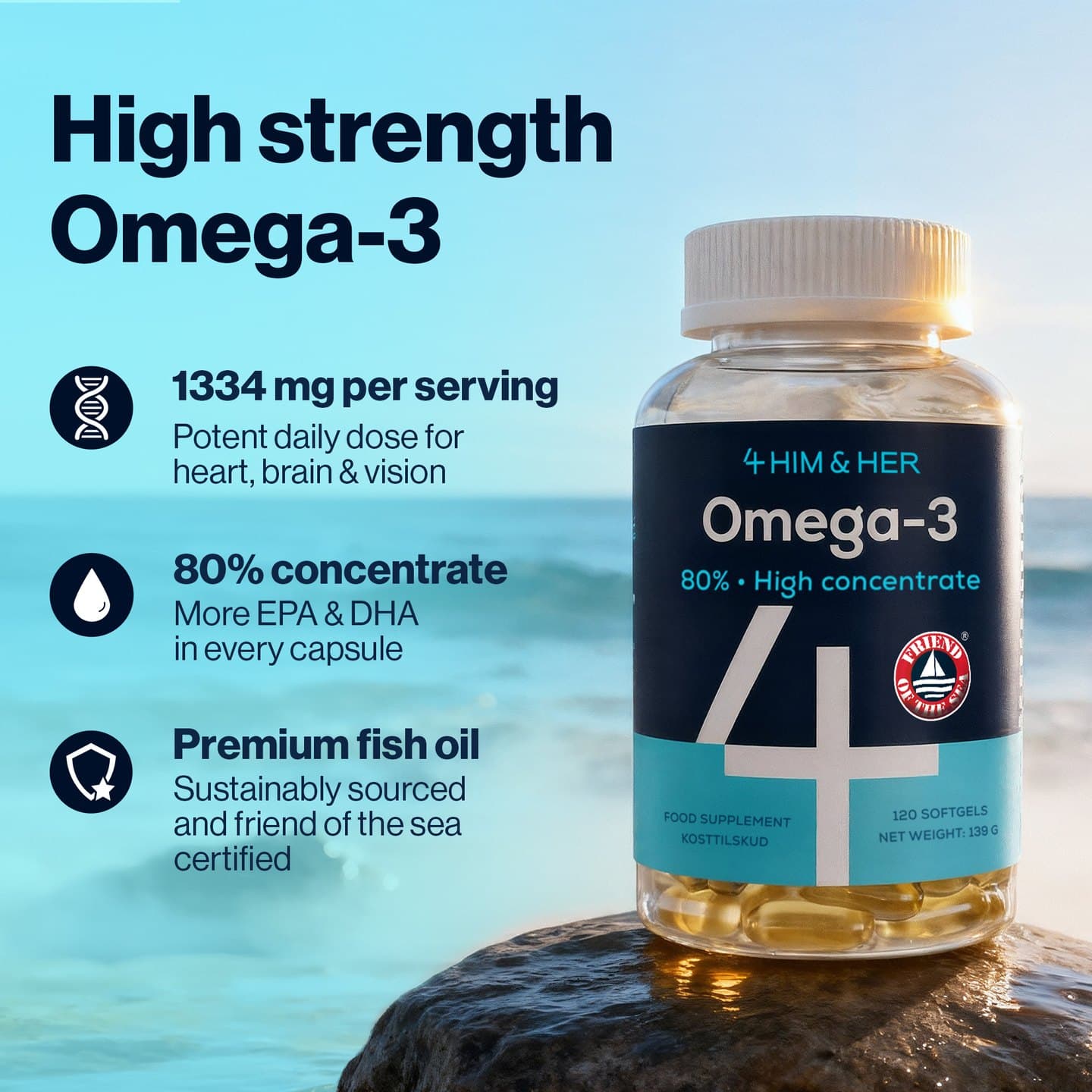
- 1,334 mgOmega-3 per serving
- 80%Fish oil concentrate
- EPA · DHA · DPAActive omega-3s
- 120 softgels60-day supply
omega-3
Why is omega-3 important?
Omega-3 fatty acids are essential fats the body cannot make on its own, so they have to come from diet or supplementation.The two most studied are EPA and DHA. EPA and DHA contribute to the normal function of the heart, and DHA contributes to the maintenance of normal brain function and normal vision. A daily serving of two capsules provides 1,334 mg of omega-3, including a concentrated amount of EPA, DHA and DPA.
Science-Backed Benefits
- Composition
80% concentrated fish oil providing 1,334 mg Omega-3 per daily dose of 2 softgels, with EPA 668 mg, DHA 500 mg and DPA 83.4 mg.
- Heart
EPA and DHA contribute to the normal function of the heart. The beneficial effect is obtained with a daily intake of 250 mg of EPA and DHA — exceeded by 2 softgels.
- Brain and vision
DHA contributes to the maintenance of normal brain function and to the maintenance of normal vision, at a daily intake of 250 mg of DHA (covered by 2 softgels).
- Form
triglyceride form (TG) — the molecular structure naturally found in oily fish, distinct from synthesised ethyl ester (EE).
- Quality
molecularly distilled, TOTOX below 10, independently laboratory tested, Friend of the Sea-certified sustainably wild-caught sardine and anchovy.
Concentrated strength
An 80% fish oil concentrate delivering 1,334 mg of omega-3 in a daily serving of two capsules.
Verified purity
Supplied in a triglyceride form and third-party laboratory tested for purity and heavy metals.
Full omega-3 profile
Provides EPA, DHA and DPA – three long-chain omega-3 fatty acids.
Quality and certifications
 GMP-Certified
 Lab-Tested
 Eurofins-Checked
 Trusted Nordic Quality
- Friend of the Sea
Product details
Molecularly distilled to EU standards to remove heavy metals, PCBs and dioxins. Friend of the Sea-certified for sustainably wild-caught anchovy and sardine — low-trophic-level species with fewer accumulated contaminants than larger fish such as cod or tuna. Free from gluten, lactose, soya, dairy and GMO. No artificial colours, no preservatives, no unnecessary fillers.
The softgel shell is bovine gelatin; this product is not suitable for vegans or vegetarians. Contains fish — not suitable for those with fish allergy. Small, neutral-tasting softgels with no fishy aftertaste and no repeat-taste burps.
From 4 HIM & HER — trusted by customers across 13 countries since 2009.
EPA and DHA contribute to the normal function of the heart
Who is it for?
A daily omega-3 supplement for adults who want to top up their intake of EPA and DHA – particularly anyone who eats little oily fish.
How and when to take it
Take two capsules daily with water, ideally with a meal. Do not exceed the recommended daily dose.
When will I notice the effects?
Omega-3 fatty acids build up in the body gradually. As a food supplement, it is intended for ongoing daily use rather than as a single dose.
What are the ingredients & benefits?
- EPA and DHA contribute to the normal function of the heart (with a daily intake of 250 mg).
- DHA contributes to the maintenance of normal brain function (with a daily intake of 250 mg).
- DHA contributes to the maintenance of normal vision (with a daily intake of 250 mg).
Nutritional information
| Fish oil | 1,668 mg |
|---|---|
| of which Omega-3 fatty acids | 1,334 mg |
| EPA (eicosapentaenoic acid) | 668 mg |
| DHA (docosahexaenoic acid) | 500 mg |
| DPA (docosapentaenoic acid) | 83.4 mg |
Why 4 HIM & HER?
- Research-backed formulation
- Quality-tested ingredients
- Third-party laboratory tested
- Made to GMP-certified standards

Friend of the Sea sourced
The fish oil is sourced from fisheries certified by Friend of the Sea, an independent certification for sustainable seafood.
Frequently asked questions
Does it taste fishy?
The oil is purified and the softgels are made to be swallowed whole, so most people notice no fishy aftertaste. Taking them with a meal can help further.
Is the fish oil sustainably sourced?
Yes. The oil comes from fisheries certified by Friend of the Sea, an independent sustainability certification for seafood.
Can I take it alongside other supplements?
Omega-3 is commonly taken as part of a daily routine with supplements such as vitamin D3 or magnesium. If you take prescribed medication, check with your doctor or pharmacist first.
How large are the capsules and how long does a pack last?
These are standard fish-oil softgels. The daily serving is two capsules, so a 120-capsule pack lasts 60 days.
What is omega-3 good for?
The two omega-3 fatty acids with recognised functions are EPA and DHA. EPA and DHA contribute to the normal function of the heart, and DHA contributes to the maintenance of normal brain function and normal vision – the heart effect is obtained with a daily intake of 250 mg of EPA and DHA, the brain and vision effects with a daily intake of 250 mg of DHA. The body cannot make these fats on its own, so they have to come from food or a supplement. A daily dose of two softgels provides 668 mg of EPA and 500 mg of DHA, 1,334 mg of omega-3 in total.
Which foods contain omega-3?
Oily fish – salmon, mackerel, sardines, herring and trout – are the main food sources of EPA and DHA. Flaxseed, chia seeds, walnuts and rapeseed oil contain ALA, a shorter-chain omega-3 that is a different fatty acid from EPA and DHA; the functions described above are those of EPA and DHA. A supplement is intended to top up what your diet provides, particularly if oily fish is not a regular part of it, rather than to replace it. Two softgels a day provide 668 mg of EPA and 500 mg of DHA.
Fish oil, cod liver oil or krill oil – what is the difference?
They are different sources of the same fatty acids. Cod liver oil is pressed from the liver of cod and also carries vitamins A and D; krill oil comes from small crustaceans; fish oil, as here, is taken from the body of oily fish and concentrated. This product is an 80% fish oil concentrate in triglyceride form, giving 1,668 mg of fish oil per two-softgel dose, of which 1,334 mg is omega-3 – 668 mg EPA, 500 mg DHA and 83.4 mg DPA. The functions described above depend on the amount of EPA and DHA you take in, not on which oil it comes from.