GB
GB Germany
 France
 Spain
Spain Italy
Italy Netherlands
 Norway
 Sweden
 Denmark
 Finland
 Portugal
How much omega-3 per day do adults need?
How much omega-3, EPA and DHA you need a day, what a portion of oily fish provides, the safe upper amount for supplements – and the signs of taking too much.


UK advice is based on food: 2 portions of fish a week, one of them oily, which works out at about 450 mg of long-chain omega-3 (EPA and DHA) a day on average. The authorised heart function of EPA and DHA is based on 250 mg a day. Supplemental EPA and DHA up to 5 g a day raise no safety concerns for adults.
How much omega-3 per day for adults?
There is no single UK “daily allowance” for omega-3, partly because the word covers different fats. It helps to separate two numbers:
- Total omega-3, mostly ALA from plant foods. UK dietary reference values (COMA, 1991) set ALA at a minimum of 0.2% of energy – a small amount that almost any diet with vegetable oils, nuts or seeds covers.
- Long-chain omega-3 (EPA and DHA) from fish and seafood. The Scientific Advisory Committee on Nutrition (SACN) recommends about 0.45 g (450 mg) a day on average, which is what 2 portions of fish a week, one of them oily, provide.
EPA and DHA are the ones that matter for the authorised functions, so that is where the rest of this guide focuses. For what they do, see omega-3 benefits.
How much EPA and DHA per day?
The authorised functions of EPA and DHA are each tied to a daily intake. That is the amount you need to take in, from food, supplements or both:
| Function | Daily intake |
|---|---|
| EPA and DHA contribute to the normal function of the heart | 250 mg of EPA and DHA |
| DHA contributes to the maintenance of normal brain function | 250 mg of DHA |
| DHA contributes to the maintenance of normal vision | 250 mg of DHA |
So 250 mg of EPA and DHA a day, with at least 250 mg of that as DHA, covers all three. The SACN figure of 450 mg is a little higher because it is a population recommendation for healthy eating rather than a claim condition. You will see much bigger numbers online – 1000 mg “for the heart”, for example – but they are not part of UK advice for healthy adults.
How much omega-3 is in a portion of fish?
Oily fish is by far the richest food source. Your body stores EPA and DHA, so the weekly total matters more than any single day – one portion can count towards several days.
| Food | Portion | EPA + DHA (approx.) |
|---|---|---|
| Salmon, farmed, cooked | 140 g | 1.5–3 g |
| Mackerel, cooked | 140 g | 2–3 g |
| Herring or kippers | 140 g | 1.5–2.5 g |
| Sardines, canned | 1 tin (about 90 g drained) | 1–1.5 g |
| Trout, cooked | 140 g | 1–1.5 g |
| Tuna, canned | 1 small tin (about 100 g drained) | 0.2–0.3 g |
| Cod or haddock | 140 g | 0.2–0.3 g |
| Egg, standard | 1 large | about 0.05 g |
One portion of salmon or mackerel a week averages out at roughly 200–400 mg a day. Canned tuna and white fish are good foods but do not count as oily fish. For more sources, including plant foods, see omega-3 foods.
How much is too much omega-3?
The European Food Safety Authority found that supplemental intakes of EPA and DHA combined of up to 5 g a day do not raise safety concerns for adults, including on bleeding, blood sugar control and immune function. That is not a target – it is roughly four times what a concentrated two-softgel dose provides.
Taking more than you need does not add benefit. The authorised functions are reached at 250 mg a day, and very high doses are where side effects become more likely.
What are the signs you might be taking too much omega-3?
- Fishy burps, an unpleasant aftertaste or bad breath
- Heartburn, nausea or an unsettled stomach
- Loose stools or diarrhoea
- Bruising more easily or nosebleeds, especially if you also take a medicine that affects blood clotting
If you notice these, cut back to the dose on the label, take it with a meal, and speak to a pharmacist if they continue. High-dose prescription omega-3 medicines have also been linked to atrial fibrillation (an irregular heartbeat) in people with heart conditions – covered in omega-3 side effects. Check your total if you combine products: cod liver oil also contains EPA and DHA, plus vitamin A.
Is it bad to take omega-3 fish oil every day?
No. For most healthy adults a daily omega-3 supplement at the dose on the label is considered safe, and daily use is how it is meant to be taken. Check with your GP or pharmacist first if you take an anticoagulant or other regular medication, or are pregnant or breastfeeding. Do not take fish oil if you are allergic to fish.
How much EPA and DHA does a supplement provide?
Labels vary a lot, so look at the EPA and DHA figures rather than the amount of fish oil. A standard 1000 mg fish oil capsule often contains only around 300 mg of EPA and DHA, because the rest is other fats.
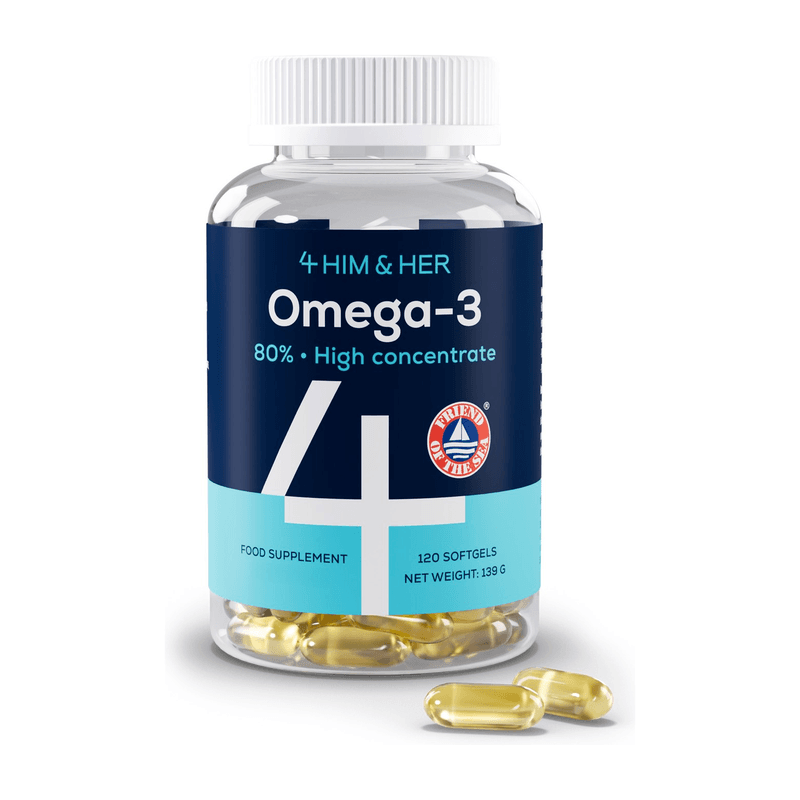
Our Omega-3 Fish Oil is an 80% fish oil concentrate. Two softgels a day provide 1668 mg of fish oil with 1334 mg of omega-3: 668 mg of EPA, 500 mg of DHA and 83.4 mg of DPA. That is 1168 mg of EPA and DHA – above the 250 mg on which the heart function is based – and 500 mg of DHA, twice the 250 mg behind the brain and vision functions. Take two softgels a day with water, ideally with a meal, and do not exceed the recommended daily dose. Not suitable for under-18s.
Frequently asked questions
How much omega-3 should I take a day?
For healthy adults, UK advice is about 450 mg of EPA and DHA a day on average, which you get from 2 portions of fish a week, one oily. The authorised heart function of EPA and DHA is based on 250 mg a day, and the brain and vision functions on 250 mg of DHA.
How much EPA and DHA per day?
250 mg of EPA and DHA combined, with 250 mg of DHA, meets the conditions for all three authorised functions. Supplemental EPA and DHA up to 5 g a day raise no safety concerns for adults, but there is no benefit in taking that much.
Is 1000 mg of omega-3 a day too much?
No. 1000 mg of omega-3 or of EPA and DHA a day is well within the 5 g a day that EFSA considers safe for adults. Check the label, as “1000 mg” often refers to the fish oil, not the EPA and DHA it contains.
Do I need a supplement if I eat oily fish?
Usually not. One portion of oily fish a week provides roughly 1.5–3 g of EPA and DHA, which averages out at around the 250 mg a day the authorised functions are based on, or more. A supplement is a top-up for people who eat little or no oily fish.
Sources
- GOV.UK – SACN advice on fish consumption: benefits and risks
- GOV.UK – Great Britain nutrition and health claims (NHC) register
- EFSA – Scientific opinion on the safety of EPA, DHA and DPA (press release)
- NHS – Fish and shellfish
- GOV.UK – Composition of foods integrated dataset (CoFID)
- British Dietetic Association – Omega-3: food fact sheet