GB
GB Germany
 France
 Spain
Spain Italy
Italy Netherlands
 Norway
 Sweden
 Denmark
 Finland
 Portugal
What is ashwagandha? The plant, the research and the rules
What ashwagandha is, what human studies have looked at – stress, cortisol, sleep, testosterone – how strong that evidence is, and where UK regulation stands.

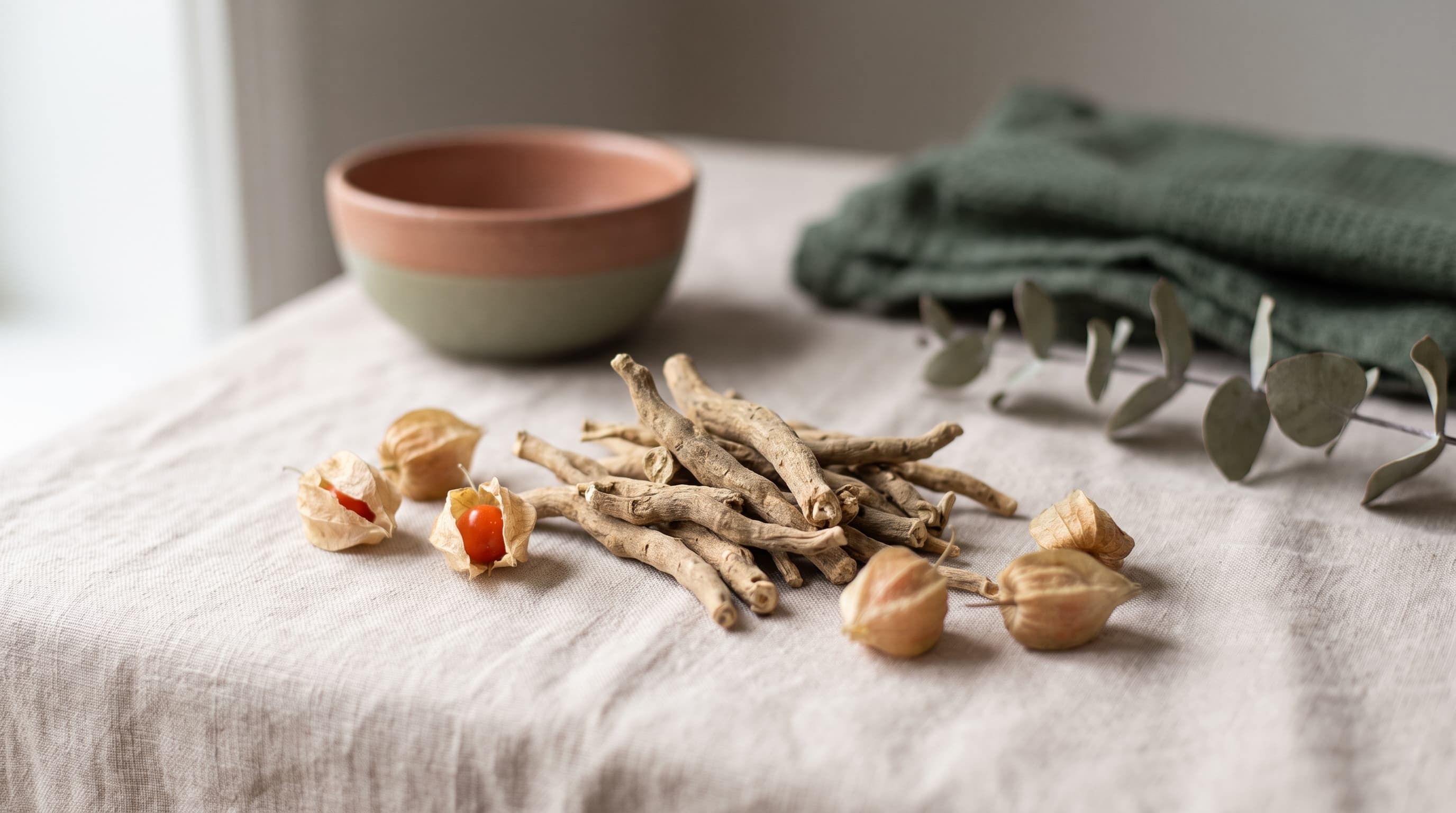
Ashwagandha (Withania somnifera) is a shrub whose root has been used in Ayurvedic tradition in India for centuries. Small human studies have measured stress scores, cortisol and sleep, mostly over eight to twelve weeks, but the evidence is limited and ashwagandha has no authorised health claim in the UK. Its safety is currently being reviewed by UK food safety advisers.
What is ashwagandha?
Ashwagandha is the common name for Withania somnifera, a small evergreen shrub in the nightshade family that grows in India, the Middle East and parts of Africa. You may also see it called Indian ginseng or winter cherry, although it isn’t related to true ginseng. The name comes from Sanskrit and is usually translated as “smell of the horse”, after the earthy smell of the fresh root.
It has been used in Ayurveda, the traditional medicine system of India, for centuries, mostly as a root powder. Today it’s sold in the UK as a food supplement – in capsules, powders and gummies – and it is one of the most searched-for herbal supplements of the past few years.
Ashwagandha is not a licensed medicine in the UK. Supplements containing it are sold as food, which means the manufacturer is responsible for their safety, but they have not been through the testing a medicine must pass.
Which part of the plant is used – root or leaf?
Traditionally, the root is the part used. Most modern clinical studies have also used root extracts. Some products use the leaf, or a mix of root and leaf, because leaves are cheaper and contain more of certain compounds – but the leaf has a different chemical make-up, and some authorities have raised specific concerns about leaf-based products.
The compounds most often measured are withanolides, a group of natural steroid-like substances characteristic of the plant. The amount varies with the part of the plant, where it was grown and how the extract is made, which is why products state the plant part and, often, the withanolide content.
What do 12:1, standardised and KSM-66 mean?
Labels describe extracts in a few different ways, and it helps to know what each one tells you:
- Root powder – dried, ground root. The cheapest form, with no concentration step.
- Ratio extract (e.g. 12:1) – roughly 12 kg of dried root was used to make 1 kg of extract. It tells you about the starting material, not how much of any particular compound the extract contains.
- Standardised extract – the extract is tested and held at a fixed level of a marker compound, typically withanolides (often 1.5%, 2.5% or 5%). That is a statement about batch-to-batch consistency, not about effect.
- KSM-66® – a branded, root-only ashwagandha extract standardised to 5% withanolides. It is one of the extracts used in several of the published studies below.
Because different studies used different extracts and doses, results from one product can’t simply be transferred to another.
What have human studies on ashwagandha looked at?
Most of the research consists of small randomised controlled trials, usually run in India, lasting eight to twelve weeks. Here is an overview of the main areas – what was measured, not what has been proven:
| Area | Example study | Who and how long | Limits |
|---|---|---|---|
| Stress scores and cortisol | Chandrasekhar et al., 2012 | 64 adults with chronic stress, 600 mg a day, 60 days | Single centre, small |
| Stress scores and cortisol | Salve et al., 2019 | 60 stressed but healthy adults, 250 mg or 600 mg a day, 8 weeks | Small, short, self-reported scales |
| Stress and anxiety scales | Lopresti et al., 2019 | 60 adults, 240 mg a day, 60 days | Different extract (240 mg); small sample |
| Sleep | Cheah et al., 2021 (review of 5 trials) | 400 participants in total | Small overall effect; more safety data needed |
| Testosterone | Lopresti et al., 2019 | Overweight men aged 40–70; 57 enrolled, 43 finished; 8 weeks | Small; no difference in fatigue or vigour |
| Strength training | Wankhede et al., 2015 | 57 men aged 18–50 new to weight training, 8 weeks | Small; men only |
| Body weight and food cravings | Choudhary et al., 2017 | 52 adults under chronic stress, 8 weeks | Small; not a weight-loss trial |
A 2022 meta-analysis in Phytotherapy Research pooled 12 trials with around 1,000 participants and reported lower stress and anxiety scores with ashwagandha than with placebo. However, the authors rated the certainty of the evidence as low, the results varied widely between trials, and they concluded that further high-quality studies are needed.
Does ashwagandha work?
The honest answer is that it hasn’t been shown well enough for any health claim to be authorised. Several small trials report differences from placebo on questionnaires and lab measurements, but:
- most trials had fewer than 100 participants and lasted no more than three months;
- several were linked to the companies that make the extracts;
- they used different extracts, doses and outcome measures, which makes them hard to compare;
- very few have been repeated by independent research groups outside India.
That is a long way from proof. It is also why responsible sellers can’t claim any effect for ashwagandha – on stress, sleep or anything else – and why you should be wary of anyone who does.
What have studies found on ashwagandha and cortisol?
Several trials have measured cortisol. In the 2012 study of 64 adults and the 2019 study of 60 adults, blood cortisol at the end of the trial was lower in the ashwagandha groups than with placebo. But these were small groups measured at only two points in time, and cortisol naturally varies a lot through the day and from day to day.
No authority has accepted any effect of ashwagandha on cortisol, and a lower lab value in a study is not the same as a health benefit. For what cortisol actually does, read Cortisol: what it does, and what high and low levels mean.
What has research looked at in men and in women?
Men: a handful of small trials have measured testosterone. In a 2019 crossover study of overweight men aged 40 to 70 (43 completed it), saliva testosterone and DHEA-S levels were higher after eight weeks of ashwagandha than after placebo, but there was no difference in fatigue, vigour or sexual wellbeing. A 2015 trial in 57 men new to weight training also measured strength and testosterone. None of this adds up to evidence that ashwagandha raises testosterone in a meaningful way.
Women: most stress and sleep trials included both men and women, and very few looked at women specifically. There’s no good evidence on hormones, menopause or periods. What is clear is the safety advice: ashwagandha should be avoided in pregnancy and while breastfeeding.
If you’re looking into ashwagandha because of symptoms such as low libido, low mood, irregular periods or menopause symptoms, see your GP first – those have causes that deserve proper assessment.
Is ashwagandha safe?
In short trials, the side effects most often reported are mild – stomach upset, drowsiness and headache. But there are rare case reports of liver injury, effects on thyroid hormones have been described, and Germany’s Federal Institute for Risk Assessment advises children, pregnant and breastfeeding women and people with liver disease not to take it. It may also interact with some medicines, including those for diabetes, blood pressure and the immune system.
We cover this in detail in Ashwagandha side effects: who should avoid it and why.
Why don’t doctors recommend ashwagandha?
Doctors base recommendations on good-quality evidence of benefit and safety. For ashwagandha, the benefit evidence comes from small, short trials, and the long-term safety data is thin. Herbal supplements also vary in strength and quality from brand to brand, which makes general advice difficult. On top of that, several food safety authorities in Europe have raised concerns, including about liver and thyroid effects.
That doesn’t mean a GP will forbid it – but it does mean you should tell your GP or pharmacist if you take it, especially if you take any medicines or have a long-term condition.
Is ashwagandha a drug, and is it legal in the UK?
In the UK, ashwagandha is sold as a food supplement, not a licensed medicine. It is currently legal to sell in food supplements, and no UK maximum amount has been set.
That may change. In summer 2024 the Food Standards Agency (FSA) ran a call for evidence on ashwagandha food supplements, and the responses are being passed to the independent Committee on Toxicity (COT) for a risk assessment. The committee discussed a second draft statement in May 2026, and at the time of writing (October 2026) no final conclusion has been published.
Elsewhere in Europe, Denmark does not allow ashwagandha in food supplements. Germany’s Federal Institute for Risk Assessment (BfR) advises that children, pregnant and breastfeeding women and people with liver disease should not take it, and notes that assessments in Denmark, the Netherlands and France also found the data too limited to set a safe intake level.
Why does ashwagandha have no authorised health claim?
Health claims on food and supplements in Great Britain must be on the GB nutrition and health claims register. Claims for plants and herbs (“botanicals”) have been on hold for years, and none has been authorised – including any for ashwagandha. So no seller may legally claim any effect of ashwagandha on stress, sleep, hormones or testosterone.
You’ll often see ashwagandha described online as an “adaptogen”. That’s a term from herbal tradition and marketing, not a recognised or authorised description of what it does.
Why is our ashwagandha combined with vitamins B5 and B6?
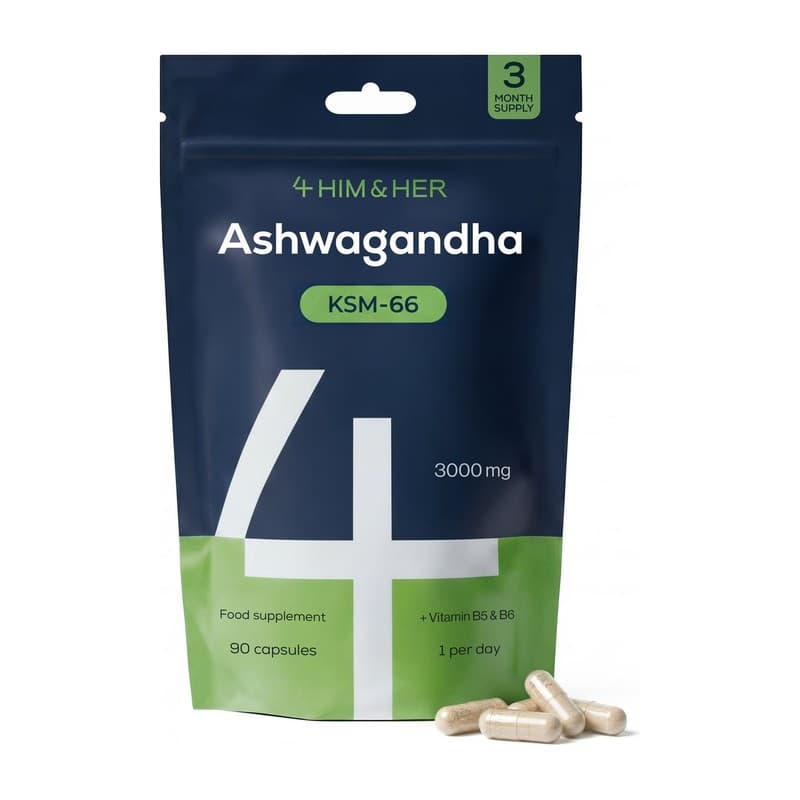
Because ashwagandha has no authorised claims, we describe it by what it is, not what it does. 4 HIM & HER Ashwagandha KSM-66® 250 mg contains 250 mg of KSM-66® root extract, standardised to 5% withanolides (12.5 mg per capsule), together with two vitamins that do carry authorised claims:
- Pantothenic acid (vitamin B5), 6 mg (100% NRV) contributes to normal mental performance.
- Vitamin B6, 2 mg (143% NRV) contributes to normal psychological function, to normal energy-yielding metabolism and to the normal functioning of the nervous system.
- Pantothenic acid and vitamin B6 contribute to the reduction of tiredness and fatigue.
It’s one vegan capsule a day with a meal, 90 capsules to a resealable pouch, made in the UK. It isn’t suitable for under-18s, and if you are pregnant, breastfeeding or taking medication, speak to your doctor before use. Practical tips are in How to take ashwagandha.
Frequently asked questions
What is the biggest benefit of ashwagandha?
No benefit of ashwagandha has been proven well enough to be authorised. The area studied most is stress, where small trials of eight to twelve weeks report lower questionnaire scores than placebo. That is a research finding, not an established effect.
Can ashwagandha increase testosterone?
A few small trials in men have measured higher testosterone after eight weeks compared with placebo, but they were short and small, and some had links to extract makers. There is no authorised claim, and it shouldn’t be taken for low testosterone – that needs a GP’s assessment.
What does ashwagandha do for women?
Very little research has looked at women specifically; most trials mixed men and women and measured stress or sleep scores. Ashwagandha has no authorised claim for women’s health and should be avoided in pregnancy and while breastfeeding.
Is KSM-66 better than other ashwagandha?
KSM-66® is a root-only extract standardised to 5% withanolides, so each batch is consistent. It has been used in several published trials, but no form of ashwagandha has an authorised health claim, and direct comparisons between extracts are lacking.
Is ashwagandha the same as ginseng?
No. It is sometimes called Indian ginseng, but Withania somnifera belongs to the nightshade family and isn’t related to Asian or American ginseng.
Sources
- Chandrasekhar K et al. A prospective, randomized double-blind, placebo-controlled study of safety and efficacy of a high-concentration full-spectrum extract of ashwagandha root. Indian J Psychol Med, 2012
- Salve J et al. Adaptogenic and anxiolytic effects of ashwagandha root extract in healthy adults. Cureus, 2019
- Lopresti AL et al. An investigation into the stress-relieving and pharmacological actions of an ashwagandha extract. Medicine (Baltimore), 2019
- Cheah KL et al. Effect of ashwagandha extract on sleep: a systematic review and meta-analysis. PLoS One, 2021
- Lopresti AL et al. Hormonal and vitality effects of ashwagandha in aging, overweight males. Am J Mens Health, 2019
- Wankhede S et al. Effect of Withania somnifera supplementation on muscle strength and recovery. J Int Soc Sports Nutr, 2015
- Choudhary D et al. Body weight management in adults under chronic stress through treatment with ashwagandha root extract. J Evid Based Complementary Altern Med, 2017
- Akhgarjand C et al. Does ashwagandha supplementation have a beneficial effect on the management of anxiety and stress? Phytother Res, 2022
- Food Standards Agency – Summary of responses to call for evidence on ashwagandha (GOV.UK)
- Committee on Toxicity – Final minutes of the 19 May 2026 meeting (GOV.UK)
- BfR – Ashwagandha food supplements with potential health risks
- GOV.UK – Great Britain nutrition and health claims (NHC) register