GB
GB Germany
 France
 Spain
Spain Italy
Italy Netherlands
 Norway
 Sweden
 Denmark
 Finland
 Portugal
How to take ashwagandha: timing, dose and how long
Morning or night, with or without food, how much and for how long: a practical guide to taking ashwagandha, and what “how long until it works” really means.


Take ashwagandha once a day with a meal, morning or evening – no study shows one time is better. Never take more than the dose on the label. Most human studies lasted eight to twelve weeks, which is why that timeframe is often quoted, but ashwagandha has no authorised health claim, so no particular effect can be promised.
How long does ashwagandha take to work?
You’ll often read that ashwagandha “takes six to eight weeks to work”. That figure comes from how long the studies ran, not from a proven effect. Most human trials gave ashwagandha daily for 8 to 12 weeks (some for 60 days), then compared questionnaires and lab tests with a placebo group.
Ashwagandha has no authorised health claim, so there is no effect anyone can honestly promise you – after a week, a month or three months. If you’re hoping to feel less stressed or sleep better, it’s worth looking at the things that are well supported first: see Symptoms of stress for practical, evidence-based steps.
When should you take ashwagandha?
Take it at the same time each day so it becomes part of your routine. The time of day itself doesn’t appear to matter – studies used both morning and evening doses, or split the dose in two, and none compared timings directly.
Do I take ashwagandha in the morning or at night?
Either. Some people prefer the evening because drowsiness is one of the side effects reported; others find it easier to remember with breakfast. If it makes you feel sleepy, take it in the evening – and don’t drive or operate machinery if you feel drowsy.
Should ashwagandha be taken with food?
Yes – taking it with a meal is the usual advice. The most common side effects are stomach upset, nausea and loose stools, and taking a capsule with food may make those less likely. Swallow it with a glass of water.
How much ashwagandha per day?
There is no official recommended amount, and no UK upper limit has been set. Studies have used anything from about 240 mg to 600 mg of root extract a day, and occasionally more, but extracts differ in strength, so those numbers can’t be swapped between products.
How long can you take ashwagandha for?
Most studies lasted no more than 12 weeks, and very few followed people for six months or longer. That means there is little evidence on long-term use, good or bad.
Some people take a break after a few months; there is no research on whether “cycling” it makes any difference, but it’s a sensible moment to ask yourself whether you still want to take it. Stop straight away and see your GP if you notice any warning signs – they are listed in Ashwagandha side effects.
Can I take ashwagandha with magnesium?
There is no known interaction between ashwagandha and magnesium, and they are often taken together. They do different things: ashwagandha has no authorised health claim, while magnesium contributes to a reduction of tiredness and fatigue and to normal psychological function.
If you take both, check whether each product also contains vitamin B6 and add the amounts together – the NHS advises not taking more than 10 mg of vitamin B6 a day from supplements unless a doctor recommends it. More in Vitamin B6: what it does, how much you need and safe limits and When is the best time to take magnesium?
Can you take ashwagandha with HRT?
There are no studies on taking ashwagandha with hormone replacement therapy. Because some trials have reported changes in sex hormones and thyroid hormones, and it may interact with some medicines, speak to your GP or pharmacist before combining the two. The same applies to the contraceptive pill and any other hormone treatment.
How do you take our ashwagandha?
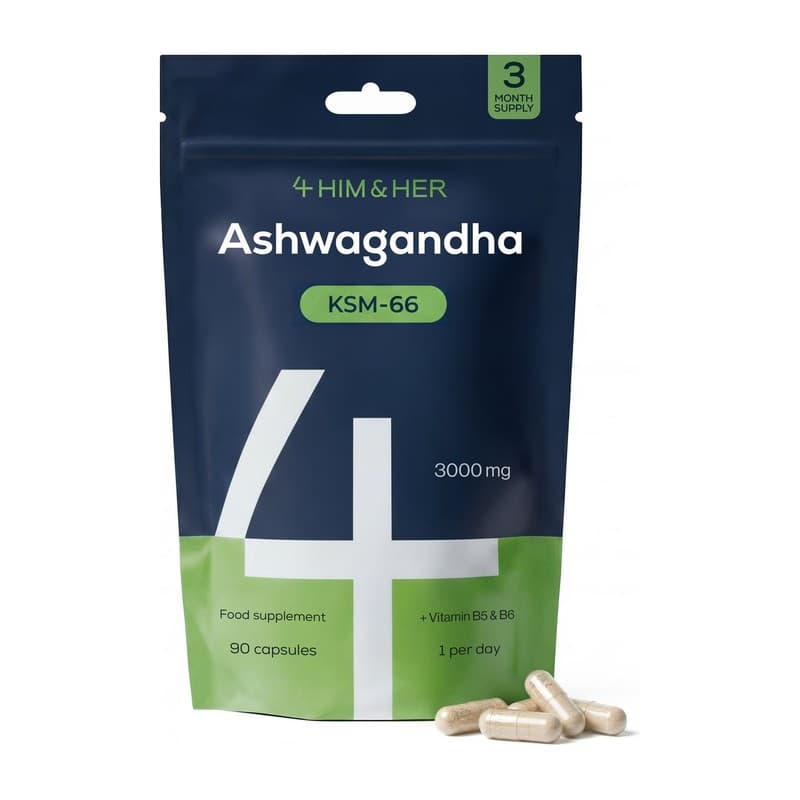
4 HIM & HER Ashwagandha KSM-66® 250 mg is one vegan capsule a day, morning or evening, with a meal. Each capsule contains 250 mg of KSM-66® root extract (standardised to 5% withanolides) with 6 mg of pantothenic acid and 2 mg of vitamin B6. A pouch of 90 capsules lasts 90 days.
- Pantothenic acid contributes to normal mental performance.
- Vitamin B6 contributes to normal psychological function.
- Pantothenic acid and vitamin B6 contribute to the reduction of tiredness and fatigue.
Don’t exceed one capsule a day. It isn’t suitable for under-18s, and if you are pregnant, breastfeeding or taking medication, speak to your doctor before use.
Frequently asked questions
Can I take ashwagandha on an empty stomach?
You can, but it’s better with food. Stomach upset is one of the most common side effects, and a meal may help to avoid it.
Can I take ashwagandha with coffee?
There’s no known interaction with caffeine. If you’re taking ashwagandha because you feel stressed or sleep badly, though, cutting back on caffeine – especially after midday – is well-supported advice in its own right.
What happens if I miss a dose?
Just take the next one at the usual time. Don’t take two to make up for it.
Can I take ashwagandha with other supplements?
Generally yes, but check labels for overlapping nutrients such as vitamin B6, and avoid combining several herbal products. If you take any medicines, check with a pharmacist first.
Sources
- Salve J et al. Adaptogenic and anxiolytic effects of ashwagandha root extract in healthy adults. Cureus, 2019
- Cheah KL et al. Effect of ashwagandha extract on sleep: a systematic review and meta-analysis. PLoS One, 2021
- Lopresti AL et al. An investigation into the stress-relieving and pharmacological actions of an ashwagandha extract. Medicine (Baltimore), 2019
- Food Standards Agency – Summary of responses to call for evidence on ashwagandha (GOV.UK)
- NHS – Vitamin B
- NHS – Herbal medicines and complementary therapies