GB
GB Germany
 France
 Spain
Spain Italy
Italy Netherlands
 Norway
 Sweden
 Denmark
 Finland
 Portugal
Creatine for women: what it does, how much and the myths
Can women take creatine? What it does for women, the same 3 g daily amount, why it won’t make you bulky, weight and water, and what menopause research shows.

Yes, women can take creatine, and the amount is the same as for men: 3 g a day. Creatine increases physical performance in successive bursts of short-term, high-intensity exercise, and that applies regardless of sex. It is not a hormone and won’t make you bulky on its own. Ask a doctor first if you are pregnant or breastfeeding.
Why are so many women asking about creatine?
For years creatine was marketed almost entirely at men in the weights room. Now more women lift, run intervals and do HIIT classes – and more research is being done on women, from young athletes to women after the menopause. Women also tend to have lower creatine stores in muscle than men, and eat less red meat on average, the main food source.
What does creatine do to women?
The same as it does in men. Creatine is stored in muscle as phosphocreatine, a quick energy reserve for short, maximal efforts. The authorised claim is not limited to one sex: Creatine increases physical performance in successive bursts of short-term, high-intensity exercise. The beneficial effect is obtained with a daily intake of 3 g of creatine.
In practice that means repeated sprints, heavy sets, circuits, and stop-start sports such as netball, hockey and football. It does not cover long-distance running or general fitness. More on how it works in What does creatine do?
Will creatine make women bulky?
No. Creatine is not a hormone and does not act like testosterone. Building a lot of muscle takes years of heavy training, plenty of food and – for most people – more testosterone than women naturally have. Creatine doesn’t change that. What you may notice is a small rise on the scales from water held inside the muscles, not fat and not a change in shape.
How much creatine should a woman take?
The same as a man: 3 g of creatine a day, the intake the authorised claims are based on. There is no separate women’s dose, and no need for a loading phase. One 3.4 g scoop of our creatine monohydrate gives 3 g of creatine. It is unflavoured and suitable for vegans.
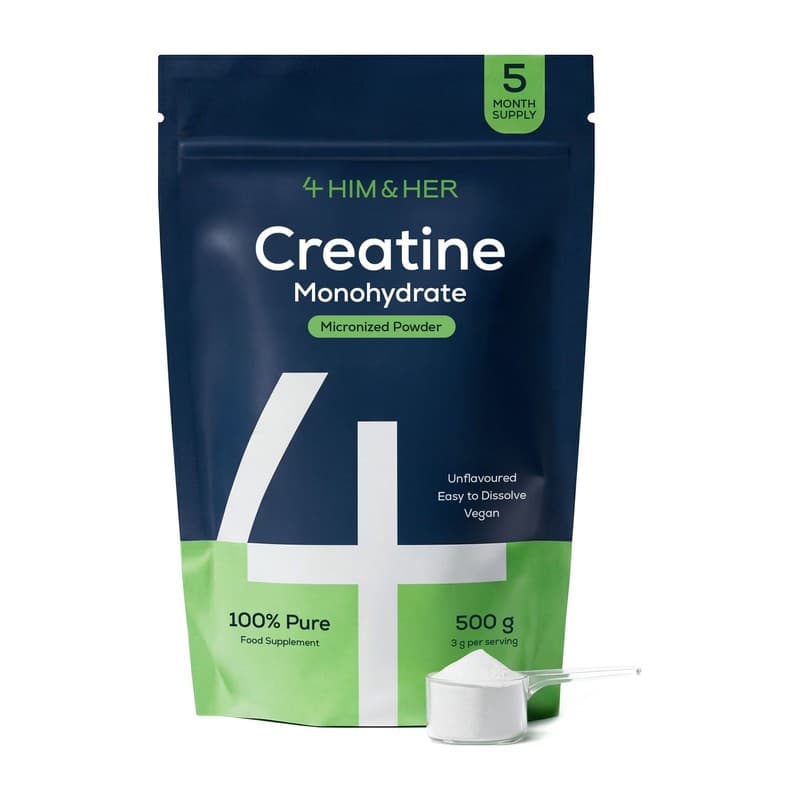
For how loading works and how long stores take to fill, see How much creatine per day.
Is creatine good for women over 55 who lift weights?
This is the one age-related use with an authorised claim: Daily creatine consumption can enhance the effect of resistance training on muscle strength in adults over the age of 55.
The condition matters. The beneficial effect is obtained with a daily intake of 3 g of creatine in conjunction with resistance training – training that increases the load over time, done at least three times a week for several weeks, at an intensity of at least 65–75% of the most you can lift once. Creatine without that training is not covered by the claim. The NHS suggests doing strength exercises at least twice a week.
When should women take creatine?
Whenever suits you. There is no evidence that the menstrual cycle changes when you should take it, and timing matters much less than taking it every day, rest days included. See When to take creatine.
Why did I gain weight after taking creatine?
Creatine draws water into muscle cells. Many people see 1–2 kg on the scales in the first weeks, mostly when they use a loading phase. It is water inside the muscle, not body fat, and it tends to level off. Taking 3 g a day without loading usually gives a smaller, slower change.
It can be confusing if you also track your weight around your period, when water retention changes anyway. Read more in Does creatine cause hair loss or weight gain?
What are the potential side effects of creatine for women?
The same as for men. The most common are the water weight above and an upset stomach from large single doses. For healthy adults at normal intakes, reviews have not found harm to the kidneys. The full picture, including who should check with a doctor first, is in Creatine side effects.
Can you take creatine when pregnant or breastfeeding?
Talk to your GP or midwife first. Creatine is being studied in pregnancy, but there is not enough research in pregnant or breastfeeding women to say it is safe as a supplement, so it is not something to start on your own. Creatine supplements are also not suitable for anyone under 18.
Can women take creatine without training?
You can, but both authorised claims are about exercise – short, high-intensity efforts, and resistance training in over-55s. Without training, there is no authorised benefit to expect.
Does creatine affect hormones in females?
Creatine is not a hormone and is not known to change oestrogen, progesterone or testosterone in a meaningful way. Researchers are interested in creatine and female hormones for a different reason: creatine metabolism appears to shift across the menstrual cycle, in pregnancy and after the menopause, as oestrogen levels change.
What does research say about creatine and the menopause?
This is an active area of research. Studies in women after the menopause have looked at creatine alongside strength training and bone, and small trials have looked at mood and brain function. Results so far are mixed, and many of the studies are small or short.
Frequently asked questions
Can women take creatine?
Yes. Creatine is a nutrient found in meat and fish and made by the body. The amount is the same as for men – 3 g a day. It is not suitable for under-18s, and if you are pregnant, breastfeeding or take medication, ask your doctor first.
Is creatine good for women over 40?
Women over 40 can use creatine in the same way as anyone else, for short, high-intensity training. From the age of 55, there is also an authorised claim: daily creatine consumption can enhance the effect of resistance training on muscle strength in adults over the age of 55, at 3 g a day with regular resistance training.
Will creatine make my face puffy?
Creatine draws water into muscle cells, not into the face. A puffy face is more likely to have another cause, such as salt, alcohol, sleep or hormonal changes across your cycle.
Does creatine help you lose weight?
No. Weight loss is not something creatine does, and you may weigh slightly more at first because of the water held in muscle.
Is creatine safe for women long term?
Studies lasting several years in healthy adults have not shown harm at normal intakes. Stick to 3 g a day, and talk to your doctor if you have a kidney condition or take regular medication.
Sources
- Smith-Ryan AE et al. – Creatine supplementation in women’s health: a lifespan perspective (2021)
- ISSN position stand – nutritional concerns of the female athlete (2023)
- Kreider RB et al. – ISSN position stand: safety and efficacy of creatine supplementation (2017)
- Commission Regulation (EU) 2017/672 – creatine and resistance training in adults over 55 (legislation.gov.uk)
- NHS – Strength exercises
- NHS – Menopause