GB
GB Germany
 France
 Spain
Spain Italy
Italy Netherlands
 Norway
 Sweden
 Denmark
 Finland
 Portugal
Iron supplements: forms, doses and who may need them
What iron does, what elemental iron and iron bisglycinate mean on a label, how 14 mg compares with prescription doses, and why a GP test comes before iron tablets.


Iron contributes to the normal formation of red blood cells and haemoglobin and to normal oxygen transport in the body. Over-the-counter iron supplements usually provide around 14 mg of elemental iron a day – roughly the NHS amount for women aged 19 to 49 – while prescription tablets contain several times more. If you think you might be low in iron, see your GP for a blood test first.
What does iron do in the body?
Iron is a mineral your body can’t make, so it has to come from food – or, where there’s a need, from a supplement. Most of it sits in haemoglobin, the protein in red blood cells that carries oxygen around the body.
The authorised health claims for iron say that it:
- contributes to the normal formation of red blood cells and haemoglobin
- contributes to normal oxygen transport in the body
- contributes to normal energy-yielding metabolism
- contributes to the reduction of tiredness and fatigue
- contributes to normal cognitive function
- contributes to the normal function of the immune system
- has a role in the process of cell division
These describe what iron does as a nutrient. They don’t mean that extra iron gives you more energy if you already get enough – which is why it pays to know whether you actually need it.
What is elemental iron?
Iron in a tablet is always bound to something else to form a compound – a salt such as ferrous sulphate, or a chelate such as iron bisglycinate. Elemental iron is the amount of actual iron in that compound, and it’s the figure that counts.
That’s why a prescription tablet can say “ferrous sulphate 200 mg” but contain about 65 mg of iron: the rest of the weight is the sulphate part. Food supplements sold in the UK state the elemental iron in the nutrition table, usually alongside a percentage of the NRV (the labelling reference value, which for iron is 14 mg).
| Compound on the label | What it is | Typical elemental iron per tablet |
|---|---|---|
| Ferrous sulphate | Iron salt (iron with sulphate) | About 65 mg in a 200 mg prescription tablet |
| Ferrous fumarate | Iron salt (iron with fumaric acid) | About 65–68 mg in a 200–210 mg prescription tablet |
| Ferrous gluconate | Iron salt (iron with gluconic acid) | About 35 mg in a 300 mg tablet |
| Iron (ferrous) bisglycinate | Iron chelated to two glycine molecules | Depends on the product – often 14 mg in a daily supplement |
What is iron bisglycinate?
Iron bisglycinate – also written ferrous bisglycinate or iron glycinate – is iron bound (chelated) to two molecules of glycine, the simplest amino acid. Chemically it’s a different compound from the iron salts used in most prescription tablets, such as ferrous sulphate and ferrous fumarate.
It has become a common choice in food supplements. Whatever the compound, the figure to compare between products is the amount of elemental iron per daily dose, and whether that amount suits you.
What dose of iron should I take?
If you’ve been prescribed iron, take exactly what your GP or pharmacist has told you. Treatment doses are much higher than everyday supplements and are given for a set period, with follow-up blood tests.
For a food supplement, the NHS says that taking 17 mg or less a day of iron supplements is unlikely to cause any harm, and that you should only take more if your GP advises it. A typical daily supplement of 14 mg sits within that. For reference, the NHS recommends 14.8 mg a day from all sources for women aged 19 to 49, and 8.7 mg for men and for women aged 50 and over – see How much iron per day?
Who might need an iron supplement?
Most people get enough iron from a varied diet. Needs are higher, and intakes more often fall short, for:
- women and girls who have periods, whose daily needs are higher – the UK’s National Diet and Nutrition Survey finds many have iron intakes below the lowest reference level
- people who eat little or no meat, as iron from plant foods is less readily absorbed
- regular blood donors
Men and women past the menopause need far less iron and rarely need a supplement unless a doctor has found a reason. If you’re tired all the time, don’t assume it’s iron – ask your GP for a blood test, because the cause matters as much as the result. More in Iron deficiency symptoms.
Why do iron supplements contain vitamin C, folate, B12 or copper?
Many iron supplements are “complexes” that add other nutrients with a related role. The authorised claims explain why each one is there:
- Vitamin C – vitamin C increases iron absorption.
- Folate – contributes to normal blood formation and to the reduction of tiredness and fatigue.
- Vitamin B12 – contributes to normal red blood cell formation and to the reduction of tiredness and fatigue.
- Copper – contributes to normal iron transport in the body.
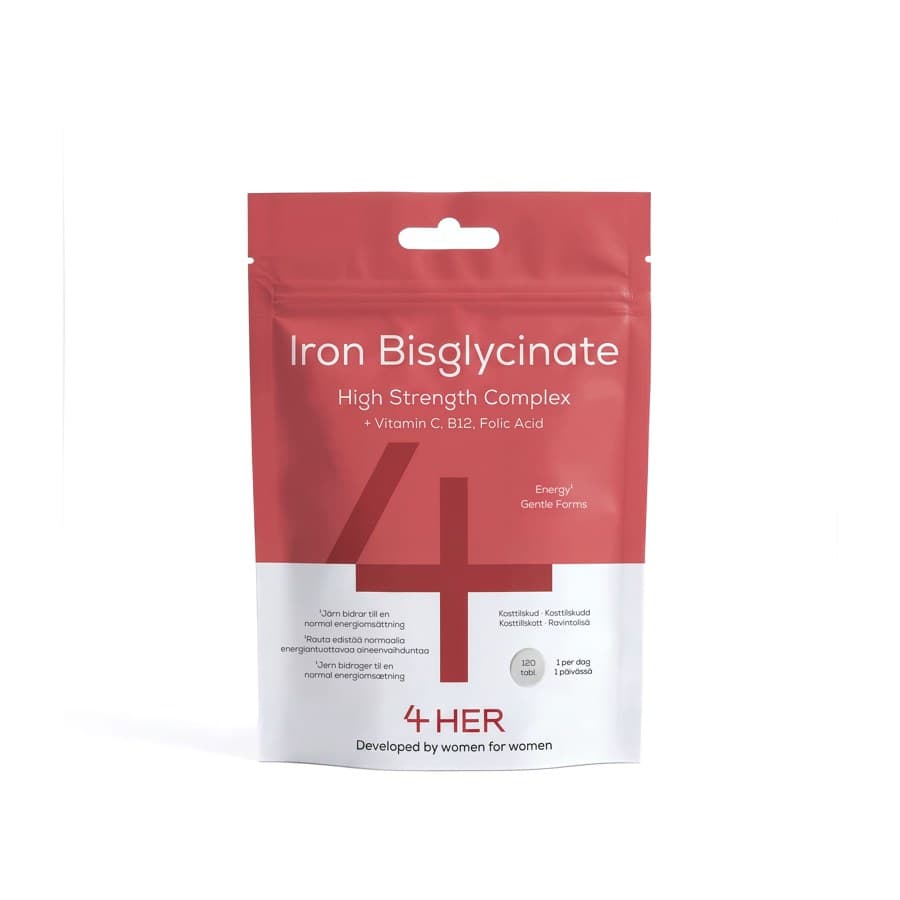
Our Iron Complex is built this way. One small, smooth vegan tablet provides 14 mg of iron as iron bisglycinate (100% NRV), together with 60 mg of vitamin C, 200 µg of folate as L-methylfolate, 3 µg of vitamin B12 as methylcobalamin and 1 mg of copper. Iron contributes to the reduction of tiredness and fatigue and to normal oxygen transport in the body. It’s for adults, one tablet a day, with or without food – a pouch of 120 tablets lasts four months.
What are the signs iron pills are working?
There isn’t a reliable feeling to go by. Iron stores build up gradually over weeks and months, and tiredness has so many causes that feeling better – or not – tells you little on its own.
If your GP has prescribed iron, they’ll usually repeat your blood test after a few weeks to check it’s working, and again later. If you’re taking an everyday supplement and still feel unwell, don’t simply take more: see your GP.
Do iron supplements have side effects?
They can. The NHS says high doses (over 20 mg) can cause constipation, feeling or being sick and stomach pain, and iron tablets can make your poo darker than usual. Too much iron over time can be harmful, and iron tablets are dangerous to young children. Read more in Iron tablets side effects.
Frequently asked questions
What is elemental iron?
It is the amount of actual iron in an iron compound. A 200 mg ferrous sulphate tablet, for example, contains about 65 mg of elemental iron. Supplement labels in the UK show elemental iron in the nutrition table.
What is iron bisglycinate?
Iron bisglycinate (ferrous bisglycinate) is iron chelated to two molecules of the amino acid glycine. It is a different compound from iron salts such as ferrous sulphate and ferrous fumarate. Compare products by their elemental iron per daily dose.
What dose of iron should I take?
If iron has been prescribed, follow your GP’s instructions. For a food supplement, the NHS says 17 mg or less a day is unlikely to cause any harm, and you should only take more on your GP’s advice.
What are the signs iron pills are working?
There is no reliable sign you can feel. Iron stores rise slowly, and only a blood test shows whether levels have changed. If you were prescribed iron, your GP will usually recheck your blood after a few weeks.
Should I take iron supplements if I feel tired?
Not without finding out why. Tiredness has many causes, and taking iron you don’t need can be harmful. See your GP, who can arrange a blood test and look for the cause.