GB
GB Germany
 France
 Spain
Spain Italy
Italy Netherlands
 Norway
 Sweden
 Denmark
 Finland
 Portugal
How much collagen per day? Doses, protein and limits
How much collagen people take a day, the doses used in studies, how collagen counts towards your daily protein, and whether you can take too much.


There is no official recommended intake for collagen, because your body makes its own and it is not an essential nutrient. Studies on skin and joints have mostly used 2.5–10 g a day, and a muscle study 15 g. Collagen counts towards your daily protein, but it lacks the essential amino acid tryptophan, so it cannot replace other protein foods.
How much collagen should I take a day?
There is no official figure. The UK government’s dietary recommendations and EFSA give reference intakes for essential nutrients – vitamins, minerals and protein as a whole – but not for collagen. Your body makes its own collagen from the amino acids in the protein you eat, so there is no amount you have to get from food or supplements.
What we do have is the range used in research. These amounts tell you what has been tested, not what you need:
| Area studied | Typical daily amount | Typical study length |
|---|---|---|
| Skin hydration and elasticity | 2.5–10 g | 8–12 weeks |
| Activity-related joint discomfort | 5–10 g | 12–24 weeks |
| Bone density (post-menopausal women) | 5 g | 12 months |
| Muscle, alongside strength training | about 15 g | 12 weeks |
Results from these studies are mixed and often modest, and no health claim for collagen is authorised in the UK. We look at what they found in Do collagen supplements work?.
Does collagen count as protein?
Yes. Collagen is a protein and provides about 4 kcal per gram, like any other. Pure collagen powder is around 90% protein or more, so it adds to your daily protein total almost gram for gram.
The UK reference nutrient intake for adults is 0.75 g of protein per kilo of body weight a day. The British Nutrition Foundation puts that at about 56 g a day for men and 45 g for women, and notes that most adults in the UK already eat more than this.
| Body weight | Protein per day |
|---|---|
| 55 kg | about 41 g |
| 65 kg | about 49 g |
| 75 kg | about 56 g |
| 85 kg | about 64 g |
Can collagen replace other protein foods?
No. Collagen is an incomplete protein: it contains no tryptophan, one of the nine essential amino acids your body cannot make, and relatively little of some others, such as leucine. Meat, fish, eggs, dairy, soya, beans and lentils give you the full set.
Collagen can still sit comfortably in a varied diet. One analysis estimated that collagen peptides could make up as much as about a third of daily protein without throwing the essential amino acid balance out, as long as the rest of the diet supplies a range of proteins.
How much protein is in a scoop of collagen?
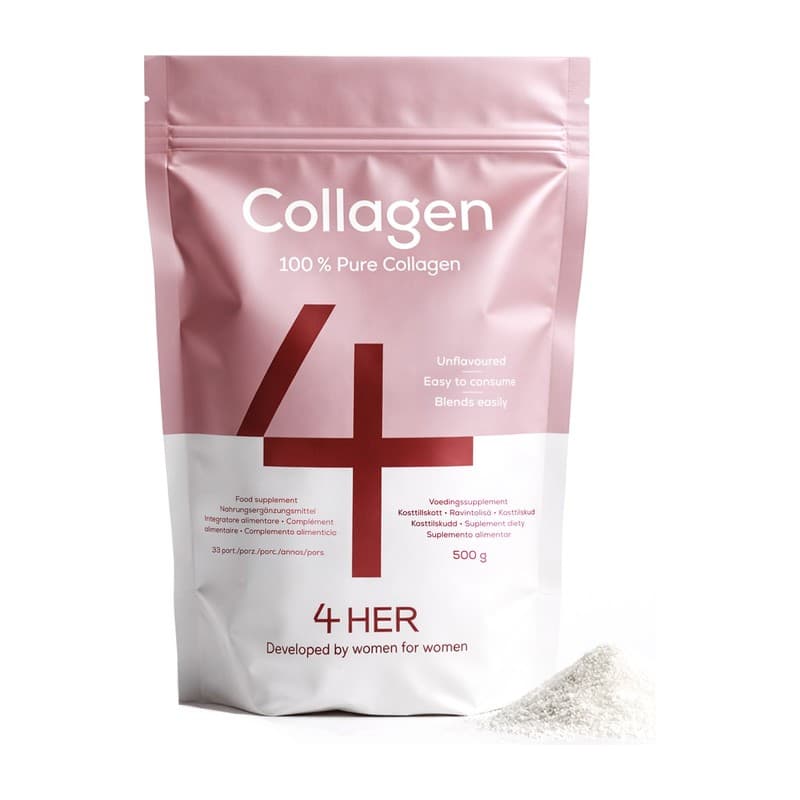
It depends on the product, so check the label for the grams of collagen and protein per serving. Our Collagen Pure is 100% hydrolysed bovine collagen, Type I and III. One level 15 g scoop – the daily serving – gives 15 g of collagen and 14 g of protein, with 0 g fat, 0 g carbohydrate and 56 kcal. For context, studies have used 2.5–15 g of collagen a day, so 15 g is at the top of that range.
Protein contributes to a growth in muscle mass. Protein contributes to the maintenance of muscle mass. Protein contributes to the maintenance of normal bones.
Can you take too much collagen?
No upper limit has been set for collagen, and none has been set for protein either – the data are not strong enough. When the UK’s protein recommendations were made, the Department of Health advised adults to avoid protein intakes of more than twice the RNI – about 112 g a day for a 75 kg man or 90 g for a 60 kg woman, from all sources combined.
More collagen is not better. Your body does not store extra amino acids for later; it uses what it needs and burns or excretes the rest. Large amounts are also more likely to cause fullness or an upset stomach. Stick to the amount on the label, and if you have kidney disease or have been told to limit protein, check with your doctor first. More in Collagen side effects.
How long does it take for collagen to work?
Studies on skin and joints usually ran for 8–12 weeks, and some for six months or a year, before measuring anything. Whether you will notice anything at all is uncertain – see the research article for what the trials actually measured.
Timing matters much less than taking a similar amount consistently. If you are wondering whether morning or evening is better, see Best time to take collagen.
Frequently asked questions
Is 10 g of collagen a day enough?
There is no amount you need. Many skin and joint studies used 2.5–10 g a day, so 10 g sits within the range researchers have tested.
Is 15 g of collagen a day too much?
No upper limit has been set. 15 g a day was used in a study on muscle and strength training, and is at the top of the 2.5–15 g range used in research. Count it as part of your total protein for the day.
How many grams are in a scoop of collagen?
It varies by brand. Check the label for the weight of one scoop and the grams of collagen and protein it gives.
Can I get enough collagen from food instead?
Your body makes collagen from the protein you eat, so you do not need to eat collagen itself. Foods such as slow-cooked tough cuts, skin-on fish and gelatine do contain it. See our article on collagen-rich foods.
Sources
- British Nutrition Foundation – Protein
- Public Health England – Government Dietary Recommendations (2016)
- Paul C et al. – Significant amounts of functional collagen peptides can be incorporated in the diet while maintaining indispensable amino acid balance (Nutrients, 2019)
- Zdzieblik D et al. – Collagen peptides with resistance training in elderly sarcopenic men (Br J Nutr, 2015)
- de Miranda RB et al. – Effects of hydrolyzed collagen supplementation on skin aging: a systematic review and meta-analysis (Int J Dermatol, 2021)
- Pu SY et al. – Effects of oral collagen for skin anti-aging: a systematic review and meta-analysis (Nutrients, 2023)
- Zdzieblik D et al. – Activity-related knee joint discomfort following specific collagen peptides (Appl Physiol Nutr Metab, 2017)
- Clark KL et al. – 24-week study on collagen hydrolysate in athletes with activity-related joint pain (Curr Med Res Opin, 2008)
- König D et al. – Specific collagen peptides and bone mineral density in postmenopausal women (Nutrients, 2018)
- GOV.UK – Great Britain nutrition and health claims (NHC) register