GB
GB Germany
 France
 Spain
Spain Italy
Italy Netherlands
 Norway
 Sweden
 Denmark
 Finland
 Portugal
What is collagen? Types, what it does and what it’s good for
What collagen is, what it does in the body, the main types, how bovine, marine and hydrolysed collagen differ, and what the evidence says about supplements.

Collagen is the most abundant protein in the body – roughly a third of all the protein you have. It is the structural protein that gives skin, tendons, ligaments, bone and cartilage their strength. Your body makes its own from amino acids in food. Collagen you eat or drink is digested like any other protein, into amino acids and small peptides.
What is collagen?
Collagen is a protein – the most common one in the human body. It makes up around a third of all the protein you carry, and it is the main building material of connective tissue: the skin, tendons, ligaments, bones, cartilage, blood vessel walls and the tissue that holds organs in place.
Under a microscope, collagen looks like rope. Three long protein chains twist around each other into a tight triple helix, and those helices bundle together into fibres. That structure is what makes collagen strong under tension – it is why a tendon can pull on a bone without tearing.
Like every protein, collagen is built from amino acids. It is unusually rich in three of them – glycine, proline and hydroxyproline – which together make up roughly half of its amino acids. Your body makes these itself, and builds its own collagen from the protein you eat.
What does collagen do in the body?
Collagen’s job is structural: it gives tissues their shape, firmness and resistance to stretching. Where it is found tells you what it does there.
- Skin – collagen forms most of the dermis, the thick layer under the surface, and gives skin its strength.
- Tendons and ligaments – almost pure bundles of collagen fibres that connect muscle to bone and bone to bone.
- Bone – collagen forms the flexible framework that minerals such as calcium are laid down on.
- Cartilage – a different type of collagen gives the cushioning cartilage in joints its structure.
- Blood vessels, gums, teeth and the eyes – all contain collagen as part of their supporting tissue.
Collagen is constantly broken down and rebuilt, at different speeds in different tissues. Production falls gradually from early adulthood onwards – a normal part of getting older, alongside sun exposure, smoking and other lifestyle factors that also affect how collagen in the skin is maintained.
What are the types of collagen?
Scientists have identified 28 types of collagen, but a handful make up almost all of it. On labels you will mostly see Types I, II and III.
| Type | Where it is found | Share of the body’s collagen |
|---|---|---|
| Type I | Skin, bone, tendons, ligaments, teeth | By far the largest – around 90% |
| Type II | Cartilage, including joint cartilage | Small |
| Type III | Skin, blood vessels, organs – often alongside Type I | Second most common in skin |
Types I and III dominate skin and bone; Type II is the cartilage collagen. Once collagen is digested, though, the type matters less than you might think – your gut breaks all of them down into amino acids and short peptides.
What happens to collagen when you eat it?
Collagen you eat – in food or as a supplement – is digested like any other protein. Stomach acid and enzymes break it into amino acids and small peptides (chains of two or three amino acids), which are absorbed into the blood. It does not travel intact to your skin or joints.
Your body then uses those amino acids wherever it needs them, to build its own collagen or any other protein. Researchers have found that some collagen-derived peptides, such as prolyl-hydroxyproline, can be measured in the blood after a collagen drink, and are studying whether they act as signals in tissues. That idea is still being investigated – it has not been shown to translate into a reliable effect.
What is the difference between hydrolysed, bovine and marine collagen?
These terms describe where collagen comes from and how it is processed – not a proven difference in what it does.
- Bovine collagen comes from cattle hides and bones. It is mostly Types I and III. It is not suitable for vegetarians or vegans.
- Marine collagen comes from fish skin and scales. It is mainly Type I. Anyone with a fish allergy should avoid it.
- Porcine collagen comes from pigs and is common in gelatine. That matters for some diets and religions.
- Hydrolysed collagen (also called collagen peptides) has been broken down with enzymes into short chains. That makes it dissolve in hot or cold drinks without setting like gelatine.
You will see claims that one source is “better absorbed” than another. Studies comparing sources are few and small, and none show that one leads to a clearly different result in the body.
What is collagen good for?
It helps to separate two questions. Collagen’s role in the body is not in doubt – it holds you together. Whether taking collagen as a supplement changes your skin, joints or bones is a different question, and the evidence is mixed.
Studies have looked at skin hydration and elasticity, activity-related joint discomfort, osteoarthritis symptoms and bone density. Some meta-analyses report modest improvements, but many of the trials are small and funded by manufacturers, and a 2025 analysis found no effect on skin when only independent or high-quality studies were counted. No health claim for collagen is authorised in the UK. We go through the trials in Do collagen supplements work?.
Is collagen good for you?
As a food, collagen is a protein, and for most people it is a perfectly safe one. Pure collagen powder is almost all protein, with no fat or sugar. It is, however, an incomplete protein: it contains no tryptophan, an essential amino acid. So it can add to your daily protein, but it cannot replace varied sources such as meat, fish, eggs, dairy, beans and lentils.
Side effects in studies have been rare and mild – mostly a feeling of fullness or an upset stomach. The source matters for allergies (fish, shellfish, egg) and diet. See Collagen side effects for who should check with a doctor or pharmacist first.
Does collagen count as protein?
Yes. Collagen is protein, so a collagen powder counts towards your daily protein intake. In the UK, the reference nutrient intake for adults is 0.75 g of protein per kilo of body weight a day – about 56 g for men and 45 g for women. How much collagen people use, and how it fits into that total, is covered in How much collagen per day?.
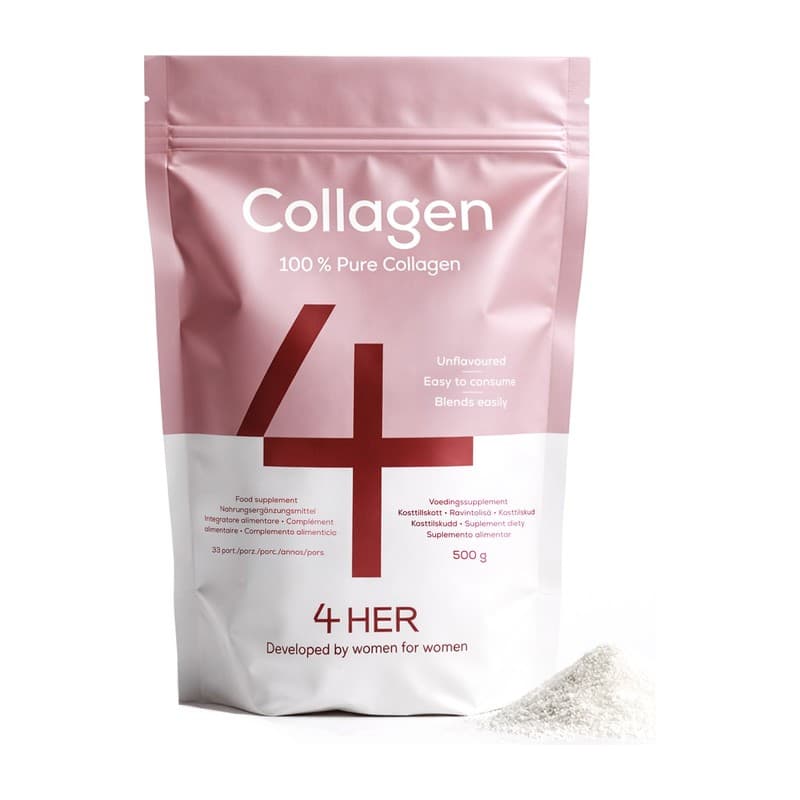
Our Collagen Pure is one ingredient – hydrolysed bovine collagen peptides, Type I and III – with nothing added. One 15 g scoop provides 14 g of protein, with 0 g fat and 0 g carbohydrate. Protein contributes to a growth in muscle mass. Protein contributes to the maintenance of muscle mass. Protein contributes to the maintenance of normal bones.
Does the NHS recommend collagen?
No. Collagen is not part of the NHS’s advice on vitamins and supplements. The NHS says most people should get all the nutrients they need from a varied and balanced diet, although some people may need supplements – for example vitamin D in autumn and winter, and folic acid before and in early pregnancy.
Frequently asked questions
What is bovine collagen?
Bovine collagen is collagen taken from cattle, mainly the hides and bones. It is mostly Types I and III, the same types found in human skin and bone. It is not suitable for vegetarians or vegans.
Is collagen vegan?
No. Collagen only comes from animals – usually cattle, pigs or fish. Plants do not make collagen. “Vegan collagen” products contain amino acids or vitamins, not collagen itself.
Is gelatine the same as collagen?
Gelatine is collagen that has been partly broken down by cooking. Hydrolysed collagen is broken down further, into shorter peptides, so it dissolves in cold liquid and does not set.
Why does collagen production fall with age?
The cells that make collagen gradually become less active from early adulthood, and the balance between building and breaking down shifts. Sun exposure and smoking also affect collagen in the skin.
Sources
- British Nutrition Foundation – Protein
- NHS – Vitamins and minerals
- NHS – Osteoarthritis
- Public Health England – Government Dietary Recommendations (2016)
- Myung SK, Park Y – Effects of collagen supplements on skin aging: a systematic review and meta-analysis of RCTs (Am J Med, 2025)
- Paul C et al. – Significant amounts of functional collagen peptides can be incorporated in the diet while maintaining indispensable amino acid balance (Nutrients, 2019)
- EFSA – Scientific opinion on collagen hydrolysate and maintenance of joints (2011)
- GOV.UK – Great Britain nutrition and health claims (NHC) register