GB
GB Germany
 France
 Spain
Spain Italy
Italy Netherlands
 Norway
 Sweden
 Denmark
 Finland
 Portugal
What is menopause? Stages, age and what to expect
Menopause explained: perimenopause, menopause and postmenopause, the average age in the UK, how long it lasts, what happens to your hormones and where to get help.


Menopause is the point when your periods have stopped for good because the ovaries have run down their supply of eggs and make far less oestrogen. It is confirmed once you have gone 12 months without a period. In the UK the average age is 51, and most women reach it between 45 and 55.
What is menopause?
Menopause is a natural stage of life, not an illness. From birth, the ovaries hold a limited number of eggs. Over the years that supply runs down, ovulation becomes less regular and eventually stops, and the ovaries produce much less of the hormones oestrogen and progesterone. Without them the monthly cycle comes to an end.
Strictly speaking, menopause is a single day: the moment 12 months have passed since your last period (as long as you are not using hormonal contraception, which can mask your periods). In everyday speech, though, "the menopause" usually means the whole transition – the years of change before and after that point.
Menopause can also happen for other reasons: surgery to remove the ovaries brings it on immediately, and some cancer treatments can cause it. It affects anyone who has periods, including trans men and non-binary people.
What are the stages of menopause?
| Stage | What it means | Typical timing |
|---|---|---|
| Perimenopause | Hormone levels start to fluctuate. Periods change – closer together, further apart, heavier or lighter – and symptoms may begin. | Often from the early to mid-40s; lasts several years |
| Menopause | The point at which you have not had a period for 12 months in a row. | Average age 51 in the UK |
| Postmenopause | Every year after that point. Oestrogen stays low for good. | The rest of your life |
Perimenopause is where most of the change happens, and it is the stage people most often mean when they say they are "going through the menopause". We cover it in depth in perimenopause: signs, age and how long it lasts.
What age does menopause start?
Most women in the UK reach menopause between 45 and 55, and the average age is 51. Perimenopause usually starts a few years before that, often in the early to mid-40s. Your age at menopause is partly inherited – it tends to be similar to your mother’s – and smoking can bring it forward.
- Early menopause is menopause before the age of 45.
- Premature menopause, also called premature ovarian insufficiency (POI), is when periods stop before the age of 40.
What happens to your hormones during menopause?
Through your reproductive years, oestrogen and progesterone rise and fall in a fairly predictable monthly pattern. In perimenopause that pattern becomes erratic: oestrogen can swing higher than usual one month and lower the next, while progesterone falls as ovulation becomes less frequent. After menopause, both settle at a low level.
Oestrogen does far more than run the menstrual cycle. It helps maintain bone density, the vaginal and urinary tissues, skin and blood vessels, and it acts in the brain. That is why its decline can show up in so many different ways – read more in oestrogen: what it does and what happens when levels fall.
The swings of perimenopause can also make premenstrual symptoms stronger for a while – see PMS. And not every hormonal change in midlife is down to menopause: an underactive thyroid, for instance, can cause similar tiredness and low mood. We explain what to rule out in signs of hormonal imbalance.
What are the symptoms of menopause?
Symptoms vary enormously. Some women barely notice the transition; others find it affects their sleep, work and relationships. The most common include:
- changes to your periods – usually the first sign
- hot flushes and night sweats
- difficulty sleeping
- low mood, anxiety, poor memory and "brain fog"
- vaginal dryness and more frequent urinary infections
- joint and muscle aches, headaches, and changes to skin and hair
For the full list, how long each tends to last and when to see a doctor, see menopause symptoms.
How long does menopause last?
Menopause itself is a point in time, but the symptoms around it are not. According to the NHS, symptoms usually last for around 7 to 9 years and sometimes longer. They also change over time: hot flushes may ease and be replaced by other symptoms, such as low mood or anxiety.
Some changes continue after menopause because oestrogen stays low. Vaginal dryness and urinary symptoms, for example, tend not to go away on their own, and bone density keeps falling more quickly than before.
At what stage is menopause the worst?
For many women, the late stage of perimenopause and the first year or two after their final period are the hardest. This is when hormone levels swing most and then drop, and when hot flushes and sleep problems are usually at their peak. But there is no fixed pattern – some people find the early, unpredictable years of perimenopause the most difficult, and a few have symptoms for well over a decade.
What is the difference between perimenopause and menopause?
Perimenopause is the lead-up: you still have periods, though they are changing, and your hormones are fluctuating. Menopause is reached once you have gone 12 months without a period. You can still get pregnant during perimenopause, so the usual advice is to keep using contraception until you have had no period for 2 years if you are under 50, or for 1 year if you are over 50.
How is menopause diagnosed?
There is usually no need for a test. If you are 45 or over, a GP can diagnose perimenopause or menopause from your symptoms and your periods alone. Hormone levels fluctuate so much in perimenopause that a single blood test often says very little.
Blood tests – usually of follicle-stimulating hormone (FSH) – may be used if you are under 45, to look for early or premature menopause. Keeping a simple diary of your periods and symptoms for a few months is one of the most useful things you can take to the appointment.
What helps during menopause?
Everyday habits make a real difference, both to how you feel now and to your long-term health. The NHS suggests:
- Regular exercise, especially weight-bearing and strength exercise to help protect your bones.
- A healthy, balanced diet with calcium-rich foods such as milk, yoghurt and kale.
- Vitamin D – the NHS advises everyone in the UK to consider a daily 10 microgram supplement in autumn and winter.
- Regular sleep routines, and relaxing activities such as yoga or meditation.
- Not smoking, and keeping alcohol within the recommended limits.
- Talking to others going through the same thing, and to your employer if symptoms affect work.
What treatment is available for menopause?
If symptoms are affecting your life, talk to your GP, a practice nurse or a pharmacist. Treatment is a medical decision made with a professional who knows your history.
- Hormone replacement therapy (HRT) replaces oestrogen, usually with a progestogen to protect the womb if you still have one. It comes as tablets, patches, gels or sprays and is the main treatment for menopausal symptoms.
- Vaginal (local) oestrogen – creams, pessaries, gels or rings – treats dryness, soreness and urinary symptoms and can be used long term.
- Non-hormonal options, including cognitive behavioural therapy (CBT) and certain prescription medicines, for people who cannot or prefer not to take HRT.
Your GP can explain the benefits and risks of each option for you. If symptoms persist, they can refer you to a specialist menopause clinic.
Which vitamins are involved in hormone function?
No vitamin or supplement treats menopause or its symptoms, and none is a substitute for medical advice. A varied diet provides the vitamins most women need. Two B vitamins do, however, have authorised functions related to hormones:
- Vitamin B6 contributes to the regulation of hormonal activity.
- Pantothenic acid contributes to normal synthesis and metabolism of steroid hormones, vitamin D and some neurotransmitters.
Good food sources of vitamin B6 include pork, poultry, some fish, peanuts, oats, bananas and milk; pantothenic acid is found in almost all meats, vegetables and wholegrain foods, with chicken, beef, eggs, mushrooms and avocado among the good sources. Women need about 1.2 mg of vitamin B6 a day. The NHS advises not taking more than 10 mg a day of vitamin B6 from supplements unless a doctor recommends it, and the European safe upper level for adults was lowered from 25 mg to 12 mg a day in 2023.
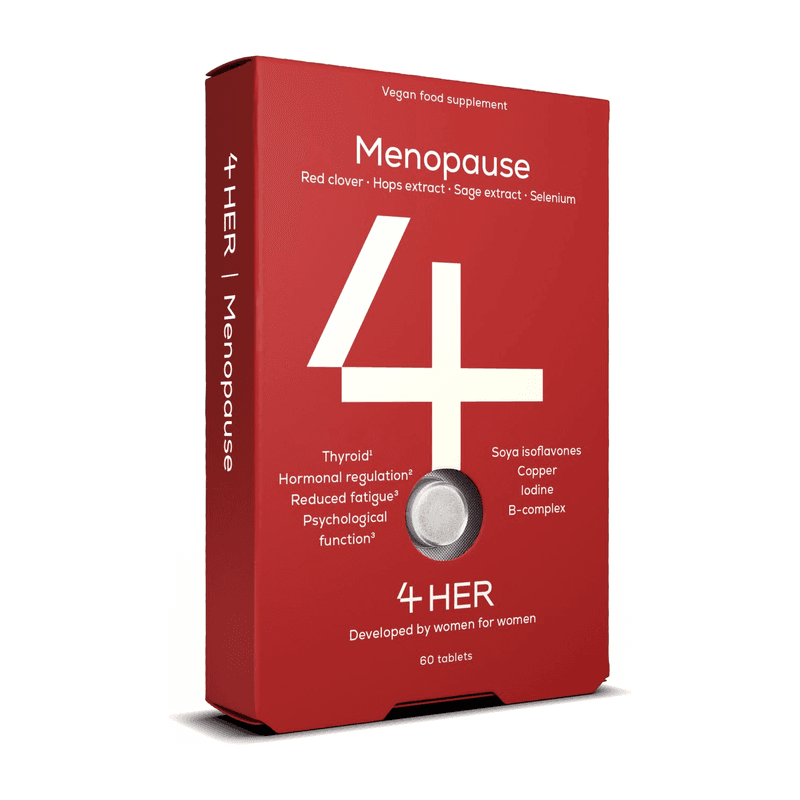
Our 4 HER Menopause is a daily supplement for women in midlife. Two tablets provide 2.1 mg of vitamin B6 (150% NRV) and 6 mg of pantothenic acid (100% NRV) – well below the upper levels above – along with nine further vitamins and minerals and three traditional plant extracts: hops, sage and red clover. The plant extracts have no authorised health claims. It is for adults; if you are pregnant or taking medication, talk to your doctor before use.
Frequently asked questions
What is menopause in simple terms?
Menopause is when your periods stop for good because your ovaries make much less oestrogen and no longer release eggs. It is confirmed when you have not had a period for 12 months. It is a normal stage of life, usually reached between 45 and 55.
What age does menopause start?
The average age of menopause in the UK is 51, and most women reach it between 45 and 55. Perimenopause, the run-up, often starts in the early to mid-40s. Menopause before 45 is called early menopause, and before 40 premature menopause – both are worth discussing with a GP.
How long does menopause last?
Menopause itself is a single point – 12 months after your last period. The symptoms around it usually last around 7 to 9 years in total, sometimes longer, and they tend to change over that time. Some, such as vaginal dryness, can continue after menopause.
When will menopause end?
Once you have gone 12 months without a period you are postmenopausal, and that stage lasts for the rest of your life. Most symptoms such as hot flushes fade within a few years of the last period, but some carry on longer. A GP can help if they are still affecting you.
Can you get pregnant during perimenopause?
Yes. You can still ovulate occasionally while your periods are irregular. The usual advice is to keep using contraception until you have had no period for 2 years if you are under 50, or for 1 year if you are over 50. HRT is not a contraceptive.
Sources
- NHS – Menopause and perimenopause
- NHS – What are menopause and perimenopause?
- NHS – Symptoms of menopause and perimenopause
- NHS – Treatment for menopause and perimenopause
- NHS – Things you can do to help menopause and perimenopause symptoms
- NHS – Early or premature menopause
- NICE NG23 – Menopause: identification and management
- NHS – Vitamin D
- NHS – Vitamin B
- GOV.UK – Great Britain nutrition and health claims (NHC) register
- British Dietetic Association – Menopause and diet
- Women’s Health Concern – Menopause factsheet