GB
GB Germany
 France
 Spain
Spain Italy
Italy Netherlands
 Norway
 Sweden
 Denmark
 Finland
 Portugal
Omega-3 foods: the richest sources, with and without fish
Which foods are highest in omega-3? Oily fish ranked by EPA and DHA per portion, plant sources of ALA, eggs, and how to get omega-3 without eating fish.

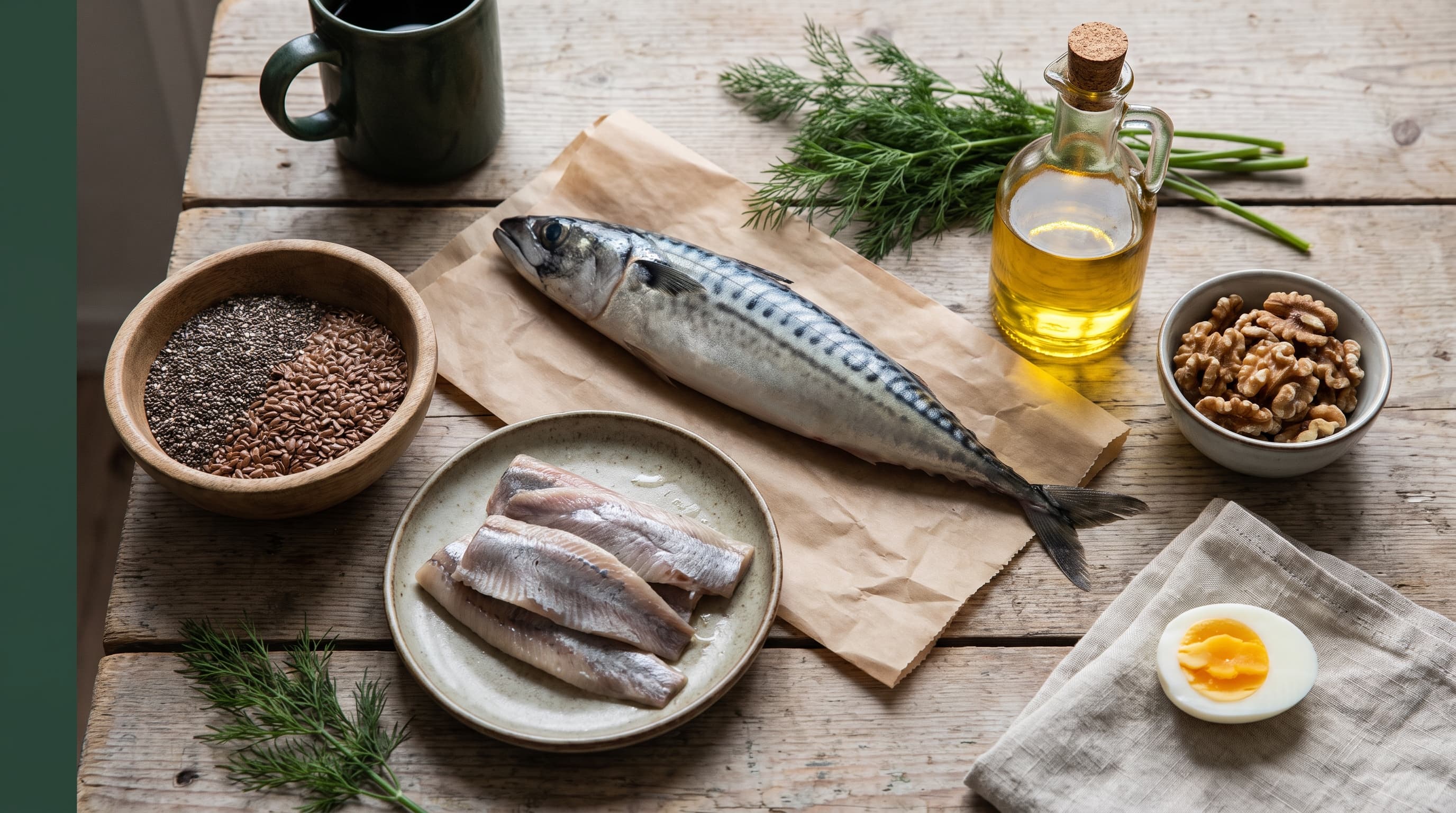
Oily fish is the richest source of the long-chain omega-3s EPA and DHA: salmon, mackerel, herring, sardines, pilchards and trout. Plant foods such as rapeseed oil, linseed, chia seeds and walnuts contain ALA, a different omega-3 the body converts only poorly into EPA and DHA. The NHS recommends at least 2 portions of fish a week, one of them oily.
Which foods are highest in omega-3?
For EPA and DHA – the omega-3s with authorised functions – oily fish is in a league of its own. The NHS counts herring (including kippers and bloaters), pilchards, salmon, sardines, sprats, trout and mackerel as oily fish.
| Food | Portion | EPA + DHA (approx.) |
|---|---|---|
| Salmon, farmed, cooked | 140 g | 1.5–3 g |
| Mackerel, cooked | 140 g | 2–3 g |
| Herring or kippers | 140 g | 1.5–2.5 g |
| Sardines or pilchards, canned | 1 tin (about 90 g drained) | 1–1.5 g |
| Trout, cooked | 140 g | 1–1.5 g |
| Smoked salmon | 50 g | 0.5–1 g |
| Crab, fresh | 85 g | about 0.3–0.5 g |
| Mussels, cooked | 85 g | about 0.5 g |
| Tuna, canned | 1 small tin (about 100 g drained) | 0.2–0.3 g |
| Cod, haddock or prawns | 140 g | 0.2–0.3 g |
| Egg, standard | 1 large | about 0.05 g |
For comparison, the authorised heart function of EPA and DHA is based on 250 mg (0.25 g) a day. One portion of salmon or mackerel a week averages out at around that amount or more. Fresh and canned tuna are not counted as oily fish in the UK.
Which plant foods contain omega-3?
Plants provide ALA (alpha-linolenic acid), not EPA or DHA. The richest sources are seeds, nuts and their oils.
| Food | Portion | ALA (approx.) |
|---|---|---|
| Walnuts | 30 g (a small handful) | 2.5 g |
| Chia seeds | 1 tablespoon (10 g) | 1.8 g |
| Ground linseed (flaxseed) | 1 tablespoon (7 g) | 1.6 g |
| Rapeseed oil | 1 tablespoon | 1.2 g |
| Hemp seeds, shelled | 1 tablespoon (10 g) | 0.9 g |
| Soya beans or edamame | 80 g | 0.3–0.5 g |
ALA is useful in its own right, and rapeseed oil – the oil most often sold as plain “vegetable oil” in the UK – is an easy everyday source. But the body converts only a small fraction of ALA into EPA, and even less into DHA, so plant foods cannot simply replace fish as a source of long-chain omega-3.
Do eggs contain omega-3?
A little. A standard egg contains a small amount of DHA – roughly 50 mg – mostly in the yolk. Some brands feed their hens a diet with added omega-3 (often linseed or algae) and label the eggs as omega-3 enriched, which can raise the content several times over. Check the label for the amount per egg.
How can I get omega-3 without eating fish?
- Use rapeseed oil for cooking and dressings, and add walnuts, ground linseed, chia or hemp seeds to porridge, yoghurt or salads every day.
- Look for foods with added omega-3: some eggs, milks, yoghurts, breads and spreads, as the British Dietetic Association notes.
- If you eat seafood but not fish, mussels and crab contain some EPA and DHA.
- For a direct source of EPA and DHA without fish, algae oil is the fish-free option – micro-algae are where fish get their omega-3 in the first place.
What are the omega-3 sources for vegans?
The NHS lists ground linseed, linseed oil, rapeseed oil, chia seeds, shelled hemp seeds and walnuts as omega-3 sources suitable for vegans, and recommends eating nuts and seeds rich in omega-3 every day. All of these provide ALA. Because conversion to EPA and DHA is limited, the British Dietetic Association notes that algae-only supplements are suitable for vegetarians and vegans who want a source of long-chain omega-3.
How much fish should you eat a week?
The NHS and the government’s scientific advisers (SACN) recommend at least 2 portions of fish a week, including 1 of oily fish. A portion is around 140 g cooked. Because oily fish can contain pollutants, there are upper limits:
- Girls and women who have not been through the menopause, including those trying for a baby, pregnant or breastfeeding: no more than 2 portions of oily fish a week.
- Boys, men and women past the menopause: up to 4 portions of oily fish a week.
- Shark, swordfish and marlin: none if you are pregnant or trying to get pregnant, and none for children under 16; no more than 1 portion a week for other adults.
Pregnancy has further rules on tuna, raw fish and smoked fish – see omega-3 in pregnancy. For how fish compares with the daily amounts, see how much omega-3 per day, and for what EPA and DHA do, omega-3 benefits.
Frequently asked questions
Which fish is highest in omega-3?
Mackerel, salmon and herring (including kippers) are usually the richest, at roughly 1.5–3 g of EPA and DHA per 140 g portion. Sardines, pilchards and trout follow. Tuna, cod and prawns contain much less and do not count as oily fish.
Is avocado high in omega-3?
No. Avocado is rich in monounsaturated fat but contains only a trace of omega-3. Walnuts, chia seeds, linseed and rapeseed oil are far better plant sources of ALA.
Does tinned fish contain omega-3?
Yes. Tinned sardines, pilchards, mackerel and salmon keep most of their omega-3 and count as oily fish. Tinned tuna is the exception: canning and the fish itself leave little omega-3, so it does not count towards your oily fish portion.
Can you get enough omega-3 from plants alone?
You can get plenty of ALA from plants, but only a small fraction is converted into EPA and even less into DHA. Vegans who want a direct source of long-chain omega-3 can use an algae-based supplement.