GB
GB Germany
 France
 Spain
Spain Italy
Italy Netherlands
 Norway
 Sweden
 Denmark
 Finland
 Portugal
What does vitamin D do? A plain-English guide
What vitamin D does in the body, D3 vs D2, where it comes from, who the NHS says should take a supplement and how to choose a strength safely.


Vitamin D contributes to the maintenance of normal bones, teeth and muscle function, to the normal function of the immune system and to normal absorption and utilisation of calcium and phosphorus. Your skin makes it in summer sunlight, but between October and early March the NHS advises everyone in the UK to consider a daily 10 microgram (400 IU) supplement.
What is vitamin D?
Vitamin D is a fat-soluble vitamin with an unusual twist: your body can make it. When UVB light from the sun hits your skin, it turns a form of cholesterol into vitamin D. The liver then converts it into 25-hydroxyvitamin D – the form a blood test measures – and the kidneys turn that into the active form the body uses.
Because it’s stored in the body’s fat and liver, the vitamin D you make in summer helps carry you some way into autumn. It isn’t enough to last the whole UK winter, which is why the NHS advice changes with the seasons.
What does vitamin D do in the body?
The functions of vitamin D that are officially recognised on the Great Britain nutrition and health claims register are:
- Vitamin D contributes to the maintenance of normal bones.
- Vitamin D contributes to the maintenance of normal teeth.
- Vitamin D contributes to the maintenance of normal muscle function.
- Vitamin D contributes to the normal function of the immune system.
- Vitamin D contributes to normal absorption and utilisation of calcium and phosphorus, and to normal blood calcium levels.
- Vitamin D has a role in the process of cell division.
Put simply, vitamin D helps the body manage calcium and phosphate – the minerals that make up bones and teeth – and plays a part in how muscles and the immune system work. Plenty of other benefits are claimed online. They are not authorised health claims, and we don’t make them.
Is vitamin D the same as vitamin D3?
Vitamin D is the umbrella name for two main forms:
- Vitamin D3 (cholecalciferol) – the form your skin makes in sunlight and the form found in oily fish, eggs and other animal foods. In supplements it usually comes from lanolin, the natural oil in sheep’s wool, or from lichen for vegan products.
- Vitamin D2 (ergocalciferol) – the form made by plants, yeast and mushrooms exposed to UV light.
Both count as vitamin D on a food label, and the UK recommendations cover either form. When someone says “vitamin D3”, they’re simply being specific about which form a product contains.
Where does vitamin D come from?
There are three sources:
- Sunlight. From about late March or early April to the end of September, the NHS says most people can make all the vitamin D they need from sunlight on their skin.
- Food. Only a few foods contain much – mainly oily fish, egg yolks, red meat, liver and fortified foods such as some fat spreads and breakfast cereals. UK cows’ milk is generally not fortified.
- Supplements. Between October and early March the sun in the UK isn’t strong enough for your skin to make vitamin D, so food and supplements are the only sources.
See how much is in everyday foods, and what affects how much you make from the sun, in Vitamin D foods and sunlight.
Who should take a vitamin D supplement in the UK?
Government advice, as set out by the NHS, is:
- Everyone over 4, including pregnant and breastfeeding women, should consider a daily supplement of 10 micrograms (400 IU) during autumn and winter.
- All year round, a daily 10 microgram supplement is recommended for people who are rarely outdoors (for example, frail or housebound), live in a care home, or usually cover most of their skin when outside.
- People with dark skin – for example of African, African-Caribbean or south Asian background – should also consider a daily supplement all year.
- Children aged 1 to 4 should have a daily 10 microgram supplement all year. Babies who are breastfed, or who have less than 500 ml of infant formula a day, should have 8.5 to 10 micrograms a day.
If you think you may be low, Vitamin D deficiency explains what the blood test means and who is most at risk.
What happens if you take vitamin D3 every day?
For most adults, taking vitamin D every day at a sensible dose is exactly how it’s meant to be used – a steady daily amount keeps your intake even. What matters is the total. The NHS says adults should not take more than 100 micrograms (4,000 IU) a day, and children aged 1 to 10 no more than 50 micrograms (2,000 IU).
Taking too much over a long period can raise calcium in the blood. Can you take too much vitamin D? covers the warning signs and the medicines that don’t mix with it.
Which vitamin D strength should you choose?
Supplements range from 10 micrograms to the 100 microgram upper limit. One microgram is 40 IU, so it helps to know where each common strength sits:
| Strength | In IU | How it compares |
|---|---|---|
| 10 µg | 400 IU | The UK daily recommendation |
| 20 µg | 800 IU | 2× the UK recommendation |
| 50 µg | 2,000 IU | 5× the UK recommendation, half the upper limit |
| 100 µg | 4,000 IU | The adult upper limit on its own |
Our everyday vitamin D3 tablet provides 50 µg (2,000 IU). That is five times the UK reference intake and half the adult upper limit, so there is room for the vitamin D you get from food. One small vegetarian tablet a day; a pouch of 365 lasts a year.

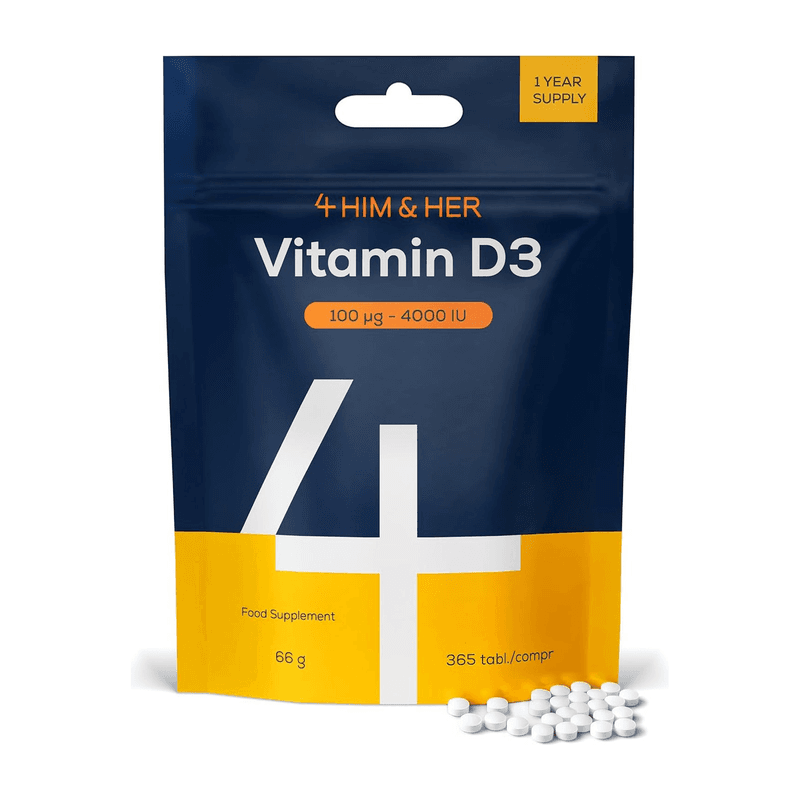
Our higher strength provides 100 µg (4,000 IU) – the adult upper limit in a single tablet. It is a dose option, not a better one, and should not be combined with other vitamin D supplements without consulting a doctor.
Should vitamin D3 and K2 be taken together?
They don’t have to be. Vitamin D works without a vitamin K supplement, and most people get the vitamin K they need from food. They are often sold together because vitamin D and vitamin K both contribute to the maintenance of normal bones, and vitamin K also contributes to normal blood clotting.
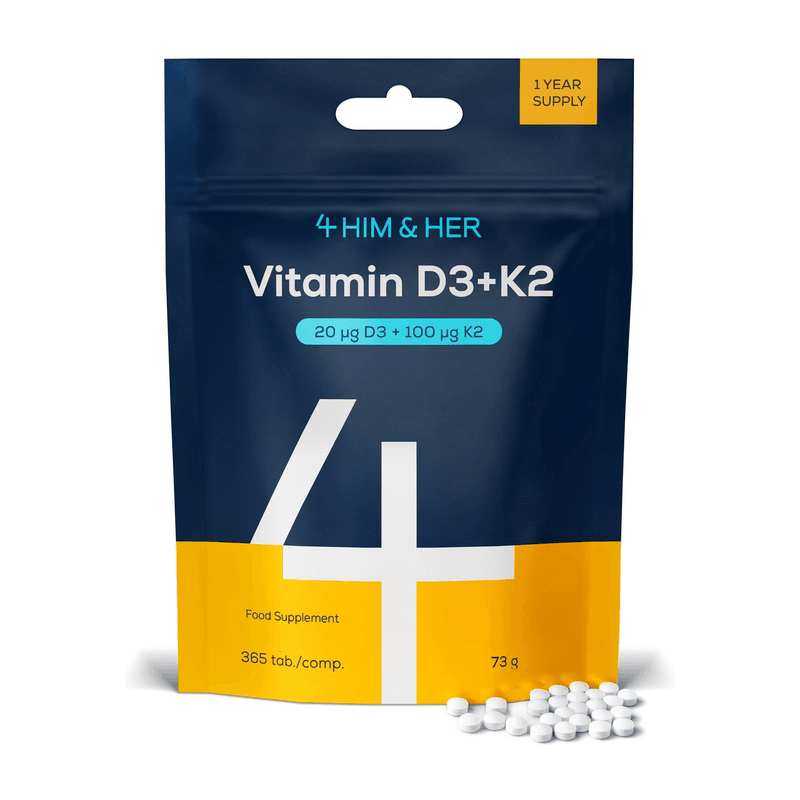
Our D3 and K2 tablet provides 20 µg (800 IU) of vitamin D3 with 100 µg of vitamin K2 as MK-7. The NHS advises not taking vitamin K supplements while you’re on warfarin; if you take any anticoagulant (blood-thinning) medicine, consult your doctor before taking vitamin K. More in Vitamin D3 and K2.
Frequently asked questions
What are the benefits of vitamin D3?
Vitamin D3 is a form of vitamin D, so it has the same recognised functions: it contributes to the maintenance of normal bones, teeth and muscle function, to the normal function of the immune system and to normal absorption and utilisation of calcium and phosphorus, and has a role in cell division.
What happens if I take vitamin D3 every day?
At a sensible dose, nothing you’d notice – daily is how vitamin D supplements are meant to be taken. The NHS says 10 micrograms a day is enough for most people, and adults should not take more than 100 micrograms (4,000 IU) a day from supplements.
Is vitamin D the same as D3?
Vitamin D3 (cholecalciferol) is one of the two main forms of vitamin D. The other is vitamin D2 (ergocalciferol), which comes from plants, yeast and UV-exposed mushrooms. Both count as vitamin D on a label.
Should vitamin D3 and K2 be taken together?
There’s no need to, but you can. Both vitamins contribute to the maintenance of normal bones, which is why they’re often combined. If you take an anticoagulant (blood-thinning) medicine such as warfarin, consult your doctor before taking vitamin K.
Is vitamin D3 vegan?
Usually not. Most vitamin D3 is made from lanolin, which comes from sheep’s wool, so it suits vegetarians but not vegans. Vegan D3 is made from lichen, and vitamin D2 is plant-based.
Do I need vitamin D in summer?
From about late March or early April to the end of September, most people in the UK can make all the vitamin D they need from sunlight and a balanced diet, so the NHS says you may choose not to take a supplement then – unless you’re in an at-risk group.
Sources
- NHS – Vitamins and minerals: Vitamin D
- SACN – Vitamin D and health report (2016)
- Public Health England – New advice on vitamin D (2016)
- Department of Health and Social Care – Great Britain nutrition and health claims (NHC) register
- NHS – Vitamins and minerals: Vitamin K
- EFSA – Scientific opinion on the tolerable upper intake level for vitamin D (2023)